

Most business owners know they should eventually plan for leaving their business. Far fewer actually put a plan in place.
Approximately 70% of business owners say exit planning matters, yet 15% or fewer actually do the work. That’s especially significant when an estimated 50% to 90% of a typical owner’s net worth may be tied up in the business.
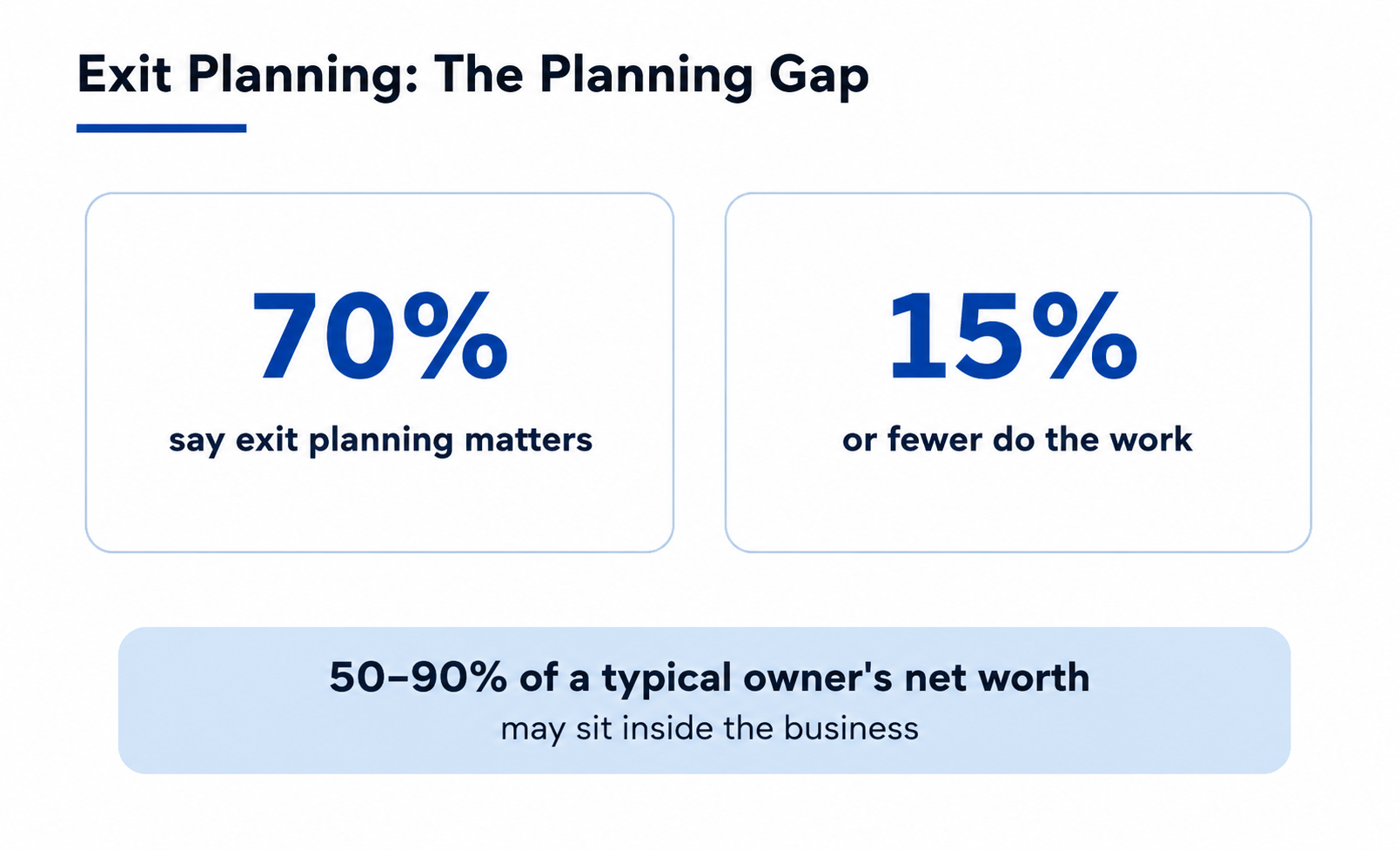
For many owners, the business isn’t just a career. It’s the retirement account.
So when should exit planning begin?
Start at Least Two to Three Years Before You Expect to Exit
Ideally, business owners should begin serious exit planning at least two to three years before their target exit date.
In some cases, five years or more may be necessary.
That time gives you an opportunity to:
 Obtain a formal business valuation
Review your business and entity structure
Clean up financial statements
Address weaknesses that could affect value
Assemble an experienced advisory team
Consider tax, estate and charitable strategies
Prepare yourself and your family for what comes next
Certain decisions simply can’t be made at the last minute. For example, some entity restructuring decisions may require years of advance planning.
Waiting until a buyer approaches you can mean discovering that some of your best options are no longer available.
“Three to Five Years” Isn’t a Plan
Ask business owners when they expect to exit, and there’s a common response:
“The answer is always three to five years. And it happens every year — three to five years.”
— Ryan, Trinity Wealth Advisors
Three to five years from now can easily become three to five years from now again next year.
The first step toward creating a real exit plan is simple:
Put a date on the calendar.
It doesn’t mean you’re obligated to sell on that date. It gives you a target that allows you and your advisors to work backward and identify what needs to happen along the way.
Pay Attention to What Your Business Is Telling You
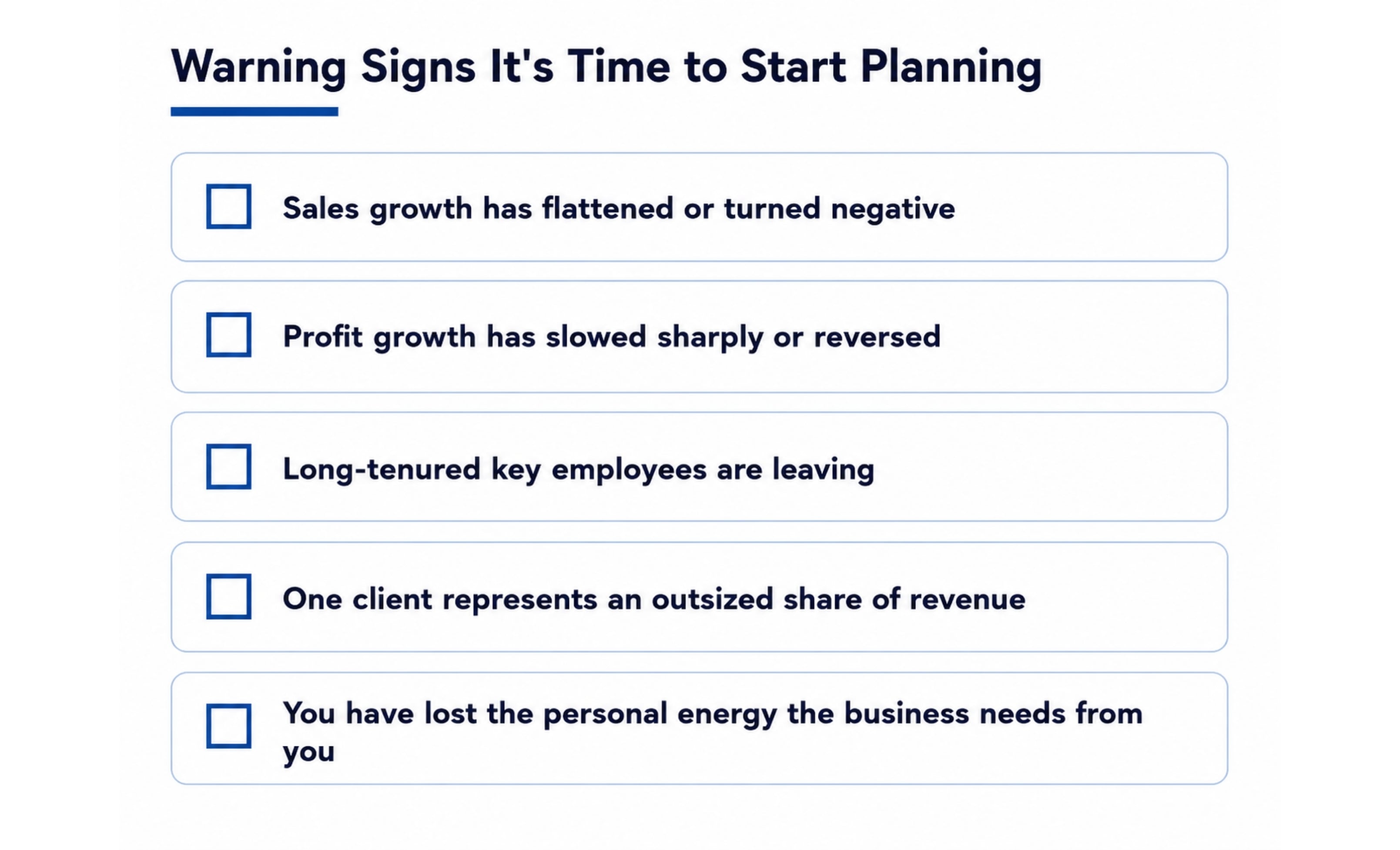
Your target date isn’t the only reason to start planning.
Sometimes the business begins signaling that it’s time.
Sales growth may flatten. Profits may begin declining. Long-tenured employees may start leaving. Or you may realize that you no longer have the same energy and enthusiasm for running the company.
“A stagnant business is not where you want to be. You don’t want to swim in a pool of stagnant water.”
— Steve Denny, Innovative Business Advisors
Those warning signs don’t necessarily mean you should immediately sell.
They mean it’s time to understand your options.
Build Your Exit Planning Team Before You Need It
Exit planning isn’t something one advisor should handle alone.
Depending on your circumstances, your team may include:
An M&A advisor
A business valuation professional
A CPA experienced in business transitions
An M&A or transactional attorney
A wealth advisor
An estate-planning professional
Experience with actual business transactions matters.
Ask your CPA how frequently they work on business transitions. Ask your attorney how frequently they handle M&A transactions.
“There are estate planning attorneys and there are transactional attorneys. You need an attorney who is used to doing M&A transactions — the wrong one can be detrimental to the deal.”
— Terry Lammers, Certified Valuation Analyst and Partner, Innovative Business Advisors
You don’t want your business sale to be someone’s opportunity to learn how business sales work.
Work Backward From Your Target Date
A simple planning timeline might look like this:
Five Years Out
Review entity structure and any decisions that may require a lengthy tax seasoning period.
Two to Three Years Out
Obtain a formal valuation, assemble your advisory team, clean up your financials and begin addressing factors that could reduce business value.
Twelve Months Out
Finalize transaction-related tax planning and evaluate charitable gifts, employee bonuses and other strategies that may need to occur before a business is under agreement.
Approaching the Sale
Review the potential tax consequences of the transaction and make sure you’re prepared financially and personally for the transition.
The important point isn’t that every owner will follow exactly the same timeline.
It’s that time creates options.
The Goal Isn’t Just a Higher Selling Price
It’s easy to think exit planning is about getting the highest possible offer.
That’s only part of the equation.
“The selling price is one thing. At the end of the day, what matters most is how much you get to keep.”
— Steve Denny, M&A Advisor and Co-Founder, Innovative Business Advisors
The earlier you begin planning, the more opportunities you may have to increase value, address risks, structure the transaction appropriately and protect the wealth you’ve spent decades creating.
You don’t need to be ready to sell to start planning.
You simply need to be ready to understand your options.
Coming Next
Part 2: Is Your Business Ready to Sell? How to Strengthen the Company Before an Exit
We’ll look at three issues that can significantly affect a future transaction: customer concentration, business structure and financial cleanup.
This article is part of our five-part business exit planning series based on insights shared during a webinar featuring Steve Denny of Innovative Business Advisors and Jim Matush and Ryan Wagner of Trinity Wealth Advisors. To hear the complete conversation and additional insights from Steve, Jim and Ryan, watch the full webinar replay on YouTube.