

When Should You Start Planning Your Business Exit? Earlier Than You Think
Most business owners know they should eventually plan for leaving their business. Far fewer actually put a plan in place.
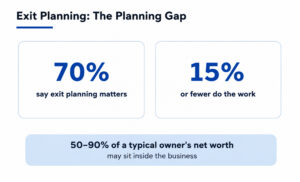
Approximately 70% of business owners say exit planning matters, yet 15% or fewer actually do the work. That’s especially significant when an estimated 50% to 90% of a typical owner’s net worth may be tied up in the business.
For many owners, the business isn’t just a career. It’s the retirement account.
So when should exit planning begin?
Start at Least Two to Three Years Before You Expect to Exit
Ideally, business owners should begin serious exit planning at least two to three years before their target exit date.
In some cases, five years or more may be necessary.
That time gives you an opportunity to:
 Obtain a formal business valuation
Review your business and entity structure
Clean up financial statements
Address weaknesses that could affect value
Assemble an experienced advisory team
Consider tax, estate and charitable strategies
Prepare yourself and your family for what comes next
Certain decisions simply can’t be made at the last minute. For example, some entity restructuring decisions may require years of advance planning.
Waiting until a buyer approaches you can mean discovering that some of your best options are no longer available.
“Three to Five Years” Isn’t a Plan
Ask business owners when they expect to exit, and there’s a common response:
“The answer is always three to five years. And it happens every year — three to five years.”
— Ryan, Trinity Wealth Advisors
Three to five years from now can easily become three to five years from now again next year.
The first step toward creating a real exit plan is simple:
Put a date on the calendar.
It doesn’t mean you’re obligated to sell on that date. It gives you a target that allows you and your advisors to work backward and identify what needs to happen along the way.
Pay Attention to What Your Business Is Telling You
Your target date isn’t the only reason to start planning.
Sometimes the business begins signaling that it’s time.
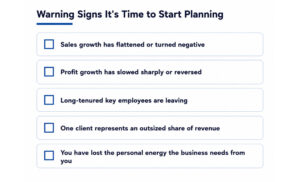
Sales growth may flatten. Profits may begin declining. Long-tenured employees may start leaving. Or you may realize that you no longer have the same energy and enthusiasm for running the company.
“A stagnant business is not where you want to be. You don’t want to swim in a pool of stagnant water.”
— Steve Denny, Innovative Business Advisors
Those warning signs don’t necessarily mean you should immediately sell.
They mean it’s time to understand your options.
Build Your Exit Planning Team Before You Need It
Exit planning isn’t something one advisor should handle alone.
Depending on your circumstances, your team may include:
An M&A advisor
A business valuation professional
A CPA experienced in business transitions
An M&A or transactional attorney
A wealth advisor
An estate-planning professional
Experience with actual business transactions matters.
Ask your CPA how frequently they work on business transitions. Ask your attorney how frequently they handle M&A transactions.
“There are estate planning attorneys and there are transactional attorneys. You need an attorney who is used to doing M&A transactions — the wrong one can be detrimental to the deal.”
— Terry Lammers, Certified Valuation Analyst and Partner, Innovative Business Advisors
You don’t want your business sale to be someone’s opportunity to learn how business sales work.
Work Backward From Your Target Date
A simple planning timeline might look like this:
Five Years Out
Review entity structure and any decisions that may require a lengthy tax seasoning period.
Two to Three Years Out
Obtain a formal valuation, assemble your advisory team, clean up your financials and begin addressing factors that could reduce business value.
Twelve Months Out
Finalize transaction-related tax planning and evaluate charitable gifts, employee bonuses and other strategies that may need to occur before a business is under agreement.
Approaching the Sale
Review the potential tax consequences of the transaction and make sure you’re prepared financially and personally for the transition.
The important point isn’t that every owner will follow exactly the same timeline.
It’s that time creates options.
The Goal Isn’t Just a Higher Selling Price
It’s easy to think exit planning is about getting the highest possible offer.
That’s only part of the equation.
“The selling price is one thing. At the end of the day, what matters most is how much you get to keep.”
— Steve Denny, M&A Advisor and Co-Founder, Innovative Business Advisors
The earlier you begin planning, the more opportunities you may have to increase value, address risks, structure the transaction appropriately and protect the wealth you’ve spent decades creating.
You don’t need to be ready to sell to start planning.
You simply need to be ready to understand your options.
Coming Next
Part 2: Is Your Business Ready to Sell? How to Strengthen the Company Before an Exit
We’ll look at three issues that can significantly affect a future transaction: customer concentration, business structure and financial cleanup.
This article is part of our five-part business exit planning series based on insights shared during a webinar featuring Steve Denny of Innovative Business Advisors and Jim Matush and Ryan Wagner of Trinity Wealth Advisors. To hear the complete conversation and additional insights from Steve, Jim and Ryan, watch the full webinar replay on YouTube.
Read More

3 Steps to Sell Your Business Quickly and Efficiently

Before delving into the specific steps that benefit business owners who are looking to sell quickly, it’s crucial to understand the buyer’s viewpoint. For many buyers, purchasing a business is a once-in-a-lifetime event, often involving significant personal and financial risk. Therefore, sellers must take proactive steps to ensure their business is as appealing and risk-free as possible.
There are three key areas to focus on for a successful exit:
- Prioritizing Pre-Diligence
- Reducing Perceived Risk
- Engaging the Right Professionals
By focusing on these areas, you can instill buyer confidence while increasing the likelihood of a smooth transaction.
Step 1: Prioritizing Pre-Diligence
The first step to preparing a business for sale is to view the process from the buyer’s perspective. Buyers will conduct due diligence to assess the financial health, legal standing, and overall stability of the business. If you are able to anticipate and address potential issues beforehand, you can streamline the process.
Well in advance, business owners should work with qualified professionals to ensure that all documentation is in order, financials are accurate, and the business complies with all relevant regulations. This pre-diligence process will create fewer hurdles during the buyer’s due diligence and provide a smoother transition to closing the sale.
Step 2: Reducing Perceived Risk
One of the most effective ways to make a business more appealing to buyers is to minimize perceived risks. Buyers are naturally cautious about purchasing a business, and any factors that raise concerns can hinder a sale.
Here are a few areas where sellers can reduce risk before listing:
- Revenue Concentration: If the business is overly reliant on a few key clients or customers, consider diversifying the customer base or developing long-term contracts that mitigate this risk.
- Employee Contracts: Secure and well-structured employee agreements can provide stability and reassure buyers that the business has a reliable workforce.
- Clear Customer Contracts: Well-drafted and easy-to-understand customer agreements can reduce legal uncertainties and increase buyer confidence.
- Addressing Legal or Financial Liabilities: If there are outstanding legal issues, potential liabilities, or financial discrepancies, it’s wise to resolve these before listing the business.
By addressing these concerns in advance, sellers can significantly increase how attractive buyers will perceive their businesses to be.
Step 3: Engaging the Right Professionals
The right team of professionals can make all the difference when selling a business. Business brokers, M&A advisors, accountants, and legal experts help guide sellers through the complexities of the sale process. They can assist with everything from developing an exit strategy to ensuring that the sale adheres to all legal and financial standards.
Engaging professionals early in the process ensures that the seller has the right advice and support to navigate negotiations, minimize risk, and maximize the business’s value. These experts can also help identify and address potential red flags that might otherwise hinder the sale.
Copyright: Business Brokerage Press, Inc.
The post 3 Steps to Sell Your Business Quickly and Efficiently appeared first on Deal Studio.

How to Know You’re Charging Enough

Most business owners fret about whether they are asking too much or not enough for their goods or services. This dilemma keeps many prospective sellers up at night. Ask too much, and you may fail to attract enough customers; ask too little, and you’re cutting yourself short. In this article, we’ll examine how to determine if you are charging the right amount for your goods and services.
Many business owners begin working with an M&A advisor or business broker only to learn that a small increase in their pricing can lead to substantial increases in profit. Best of all, with the right pricing strategy, it is possible to raise your prices without your customers noticing. The fact is, you may be leaving a significant amount of money on the table right now. Having a coherent and well-thought-out pricing strategy is the first step to boosting your profits, and it can be done in surprisingly little time.
In Rafi Mohammed’s book “The Art of Pricing,” he observes that a key fallacy in business is that a product’s price should always be based on its manufacturing cost. Mohammed offers several interesting observations and suggestions. One suggestion, specifically aimed at restaurants, is that they should keep their entrée prices attractive and expect their profits to come from items like drinks, desserts, or other add-ons. He notes that McDonald’s profit margin on hamburgers is small, but they have a considerable profit margin on French fries and drinks. In short, profits and pricing should be viewed as part of a larger overarching strategy.
Another example can be found in the world of investment banks, which charge a relatively modest accomplishment fee as a percentage of total consideration. However, they then insert a substantial minimum fee.
Better pricing and better pricing strategies lead to more profits. Through better pricing, Mohammed argues that companies can increase their profits and achieve growth. He notes, “Smart pricing is like hidden profits.”
The more time you, as a business owner, invest in your pricing strategy, the greater the chances are that you’ll boost the value of your business. The facts are that small pricing increases can significantly enhance overall profits. Don’t be afraid to adopt a new pricing strategy. If your new pricing strategy fails, you can adjust your plan. The benefits of exploring new pricing options are simply too great to ignore.
Copyright: Business Brokerage Press, Inc.
The post How to Know You’re Charging Enough appeared first on Deal Studio.

Negotiating the Price Gap Between Buyers and Sellers

Sellers generally desire all-cash transactions; however, oftentimes partial seller financing is necessary in typical middle market company transactions. Furthermore, sellers who demand all-cash deals typically receive a lower purchase price than they would have if the deal were structured differently.
Although buyers may be able to pay all-cash at closing, they often want to structure a deal where the seller has left some portion of the price on the table, either in the form of a note or an earnout. Deferring some of the owner’s remuneration from the transaction will provide leverage in the event that the owner has misrepresented the business. An earnout is a mechanism to provide payment based on future performance. Acquirers like to suggest that, if the business is as it is represented, there should be no problem with this type of payout. The owner’s retort is that he or she knows the business is sound under his or her management but does not know whether the buyer will be as successful in operating the business.
Moreover, the owner has taken the business risk while owning the business; why would he or she continue to be at risk with someone else at the helm? Nevertheless, there are circumstances in which an earnout can be quite useful in recognizing full value and consummating a transaction. For example, suppose that a company had spent three years and vast sums developing a new product and had just launched the product at the time of a sale. A certain value could be arrived at for the current business, and an earnout could be structured to compensate the owner for the effort and expense of developing the new product if and when the sales of the new product materialize. Under this scenario, everyone wins.
The terms of the deal are extremely important to both parties involved in the transaction. Many times the buyers and sellers, and their advisors, are in agreement with all the terms of the transaction, except for the price. Although the variance on price may seem to be a “deal killer,” the price gap can often be resolved so that both parties can move forward to complete the transaction.
Listed below are some suggestions on how to bridge the price gap:
- If the real estate was originally included in the deal, the seller may choose to rent the premise to the acquirer rather than sell it outright. This will decrease the price of the transaction by the value of the real estate. The buyer might also choose to pay higher rent in order to decrease the “goodwill” portion of the sale. The seller may choose to retain the title to certain machinery and equipment and lease it back to the buyer.
- The purchaser can acquire less than 100% of the company initially and have the option to buy the remaining interest in the future. For example, a buyer could purchase 70% of the seller’s stock with an option to acquire an additional 10% a year for three years based on a predetermined formula. The seller will enjoy 30% of the profits plus a multiple of the earnings at the end of the period. The buyer will be able to complete the transaction in a two-step process, making the purchase easier to accomplish. The seller may also have a “put” which will force the buyer to purchase the remaining 30% at some future date.
- A subsidiary can be created for the fastest growing portion of the business being acquired. The buyer and seller can then share 50/50 in the part of the business that was “spun-off” until the original transaction is paid off.
- A royalty can be structured based on revenue, gross margins, EBIT, or EBITDA. This is usually easier to structure than an earnout.
- Certain assets, such as automobiles or non-business-related real estate, can be carved out of the sale to reduce the actual purchase price.
Although the above suggestions will not solve all of the pricing gap problems, they may lead the participants in the necessary direction to resolve them. The ability to structure successful transactions that satisfy both buyer and seller requires an immense amount of time, skill, experience, and most of all – imagination.
The post Negotiating the Price Gap Between Buyers and Sellers appeared first on Deal Studio – Automate, accelerate and elevate your deal making.