New SBA Rules Take Effect October 1, 2026 — What Every Seller Needs to Know
Starting October 1, 2026, the SBA’s updated lending rules change how business sales are financed through the 7(a) loan program. Seven changes matter most to sellers: every deal needs an independent valuation, $3 million-plus deals require a Quality of Earnings report with a Cash Proof, the debt service coverage ratio rises to 1.25:1, loan amortization is capped at 10 years, sellers can stay involved as consultants for up to 24 months, earnouts are prohibited, and seller note refinancing seasoning goes from 24 to 36 months. This post puts all the pieces together in one place so you know what to expect, what to plan for, and what to do now.
Key Takeaways
 These seven changes apply to every SBA-financed business sale with a loan number issued on or after October 1, 2026.
The combined effect raises the bar on financial due diligence and tightens what a given cash flow will support in debt.
Sellers with clean books, realistic pricing, and early planning are in the strongest position.
Deal structures that relied on earnouts, projections, or long amortization need to be rethought.
The seller-friendly changes — longer consulting periods and clearer guarantee terms — give you more transition options.
How Do the New Valuation Rules Affect My Sale?
Every SBA-financed business sale now requires an independent business valuation from a credentialed professional — no exceptions. The previous rules let banks do their own valuation on smaller deals (those under $250,000 in business-only financing). That threshold is gone.
The valuation must be ordered by and prepared for the bank. A valuation you obtained for your own planning purposes will not satisfy the requirement. A valuation the buyer obtained will not either. The bank picks the valuator, defines the scope, and receives the report.
If the purchase price exceeds the valuation, the buyer must cover the difference with additional equity — their own cash. The bank will not lend against a gap between the price and the value.
What this means for you: Get your own valuation done before you go to market. Not because the bank will accept it, but because you need to know what number the bank’s valuation is likely to come back with. Pricing your business above what it will appraise for creates a gap that kills deals. Pricing it at or near its supportable value creates a deal that closes.
What Is the Quality of Earnings Requirement?
For Initial Acquisition and Business Expansion deals with a purchase price of $3 million or more, the bank must also order a Quality of Earnings report. The threshold is measured on the purchase price before applying buyer equity, seller debt, or any other financing — so it cannot be structured around.
The QoE goes deeper than a valuation. It examines whether the earnings are real, recurring, and sustainable. The SBA requires it to include a Cash Proof — a forensic-level analysis that reconstructs cash receipts and disbursements by matching bank statement data against the income statement and tax return. The Cash Proof must cover a trailing 12-month period and the last two full fiscal years.
The QoE must document all add-backs and adjustments, assess customer concentration risk, evaluate contract continuity, and determine whether revenue and margins will hold after the sale. The bank must use the QoE-adjusted earnings — not the seller’s reported numbers — to calculate debt service coverage.
What this means for you: If your business is likely to sell for $3 million or more, every dollar flowing through it will be traced from the bank account to the income statement to the tax return. Unreported income, undisclosed expenses, aggressive add-backs, and related-party transactions will surface. The time to clean this up is 18 to 24 months before you go to market. If your books are already clean, the QoE process will confirm your value. If they are not, the QoE will reduce it.
Why Does the Debt Service Coverage Ratio Matter?
Under the previous rules, most business sales needed a debt service coverage ratio of 1.15:1 — meaning the business had to earn $1.15 for every $1.00 of debt payments. The new rules raise that to 1.25:1 for Initial Acquisitions, Owner Buyouts, and ESOP/Cooperative transactions. Business Expansions remain at 1.15:1.
Here is why that 10-point difference matters. Debt service coverage is the ratio that determines how much debt a given cash flow can support. When the required ratio goes up, the maximum supportable debt goes down — and with it, the maximum purchase price.
A simple example: a business generates $500,000 in annual cash flow (EBITDA). At a 1.15:1 ratio, that cash flow supports roughly $435,000 in annual debt service. At a 1.25:1 ratio, it supports roughly $400,000. That $35,000 annual difference translates to a meaningfully lower loan amount over a 10-year term.
There is a second change that compounds this. Under the old rules, projections could satisfy the debt service requirement — the buyer could show that earnings would grow into the required ratio within two years. Under the new rules, the lender must evaluate projections but may not rely on them to meet the DSC requirement. Historical earnings must carry the debt. The “buyer will grow into it” argument no longer works.
What this means for you: Your business’s trailing earnings are now the ceiling on what the SBA-financed portion of the deal can support. Strengthening those earnings before you sell — by controlling costs, documenting revenue, and building recurring income — directly increases what your business can sell for.
What Is the 10-Year Amortization Cap?
The SBA now requires that the business portion of a change of ownership loan be amortized over no more than 10 years. The loan may not have a balloon payment.
If the deal also includes real estate, the real estate portion may be amortized over up to 25 years. The lender can structure this as either two separate loans (one for the business, one for the real estate) or a single blended loan using a weighted average. But all non-real-estate uses of proceeds — including soft costs and working capital — must be allocated a 10-year term.
The SBA 504 program cannot be used on a blended basis with a change of ownership loan.
What this means for you: A shorter amortization means higher monthly payments, which makes the debt service coverage ratio harder to hit. Combined with the higher DSC requirement, this further limits how much debt a given cash flow can carry. On the other hand, it also means the buyer builds equity in the business faster, which reduces the bank’s risk — and may make lenders more willing to approve deals that are otherwise on the margin.
Can Sellers Stay Involved Longer?
Yes. The SBA doubled the time a seller can stay on as a paid consultant from 12 months to 24 months, including any extensions. This applies to Initial Acquisitions and Business Expansions.
In a Partial Change of Ownership, the seller has even more flexibility. The seller may remain as an owner, officer, director, stockholder, Key Employee, or employee — whatever role makes sense for the business.
A selling owner who retains less than 20% ownership after the sale must provide a full personal guarantee of the full loan amount for at least two years. But the SBA clarified that these guarantors are not required to pledge their personal residence or other personal assets in a collateral shortfall.
What this means for you: You have more time to help with the transition, which is good for you, good for the buyer, and good for the business. If you are considering keeping a small stake, understand the guarantee obligation — and understand that it does not extend to your personal property. This clarity removes a common deal-killer.
Are Earnouts Still Allowed?
No. Under the new rules, seller earnouts are prohibited on SBA-financed business sales. An earnout is a payment to the seller that is contingent on the business hitting certain performance targets after the sale closes.
Buyer rebates tied to business performance are allowed. The difference: an earnout pays the seller more if the business does well, while a rebate reduces the buyer’s cost if the business does well. When the buyer receives a rebate, the proceeds must be applied to pay down the principal balance of the 7(a) loan. The SBA confirmed that this principal reduction does not trigger a subsidy recoupment fee.
What this means for you: If you have been thinking about structuring part of your sale price as an earnout — for example, to bridge a gap between what you want and what the buyer will pay — that option is off the table for SBA-financed deals. The price must be set at closing. If the buyer’s bank is an SBA lender, the deal structure needs to reflect the full agreed price up front.
What Changed with Seller Note Seasoning?
When a seller carries a note as part of the deal — meaning you finance part of the purchase price yourself — that note must be on full standby to count as equity. Full standby means no payments of principal or interest for the life of the 7(a) loan.
Under the previous rules, a seller note structured as part of an SBA-financed deal was eligible for refinancing (being replaced with a new loan) after 24 months. The new rules extend that to 36 months.
What this means for you: If you carry a seller note on standby, you will wait three years — not two — before the buyer can refinance it and start making payments to you. This extends your exposure window and delays the point at which you start receiving payment on that portion of the purchase price. Factor this into your financial planning and your expectations about when you will be fully paid.
What Should I Do Right Now?
If you plan to sell your business in the next one to five years, here is how to use this information.
- Get a preliminary valuation. Understand what your business is worth today under the standards a bank will apply. This is not a listing price — it is a reality check. IBA performs these valuations regularly and we offer special incentives for “Informational Business Valuations.”
- Clean up your books. Make sure your internal financial statements, tax returns, and bank statements tell the same story. If a Cash Proof would find discrepancies today, fix them now — not during due diligence.
- Know your numbers. Calculate your trailing EBITDA, your post-transaction debt service, and your DSC ratio. If it does not hit 1.25:1, identify what needs to change before you go to market.
- Plan your transition. With 24 months of consulting time available, you can build a real handoff plan. Buyers pay more for businesses where the transition risk is low.
- Talk to your advisor early. These rules change how deals are structured, priced, and financed. The earlier you plan, the more options you have.
The businesses that sell well under these new rules will be the ones with clean books, documented earnings, realistic pricing, and owners who planned ahead. That has always been true. The SBA just made it official.
Frequently Asked Questions
When exactly do these rules take effect? The new rules apply to any 7(a) loan application that receives an SBA loan number on or after October 1, 2026. Applications that already received a loan number before that date are processed under the previous rules (as of August 2026).
Do these rules apply to all business sales? They apply to business sales financed through the SBA 7(a) loan program. Deals financed entirely with conventional bank loans, private equity, or cash are not subject to SBA SOP requirements — although conventional lenders may apply similar standards.
Can I still use seller financing? Yes. Seller notes remain an important part of deal structures. If the note is on full standby, it can count toward the buyer’s equity injection (up to half). The change is that the note must season for 36 months before it can be refinanced, up from 24.
What if my business is worth less than $3 million? You still need an independent business valuation, but you are not subject to the Quality of Earnings requirement. The DSC ratio, 10-year amortization cap, and all other provisions still apply.
Are these rules likely to change again? SBA lending rules are updated periodically. The SBA has issued nine versions of SOP 50 10 since 2008. However, these changes represent a deliberate tightening of change of ownership requirements, and there is no indication they will be rolled back in the near term.
This is Part 4 of a four-part series on the SBA’s new lending rules effective October 1, 2026.
The information in this post is based on SBA SOP 50 10 8.1. It is general information, not legal, tax, or lending advice. Consult your M&A advisor, lender, and legal counsel about your specific situation.
Read More
New SBA Rules Mean Every Business Sale Needs an Independent Valuation — Here’s What Changed
The SBA’s updated lending rules eliminate the old $250,000 threshold that let banks perform their own business valuations on smaller deals. Starting October 1, 2026, every business sale financed with an SBA 7(a) loan requires an independent valuation from a qualified professional — ordered by the bank, not the buyer or seller. Deals with a purchase price of $3 million or more also require a Quality of Earnings report that includes a Cash Proof. These changes raise the bar on financial due diligence, and sellers who keep clean, well-documented books will be in the strongest position.
Key Takeaways
Every SBA-financed business sale now requires an independent business valuation from a Qualified Source — no exceptions.
The valuation must be ordered by and prepared for the lender. A valuation prepared for the buyer or the seller cannot be used.
If the purchase price exceeds the valuation, the difference must be covered by additional buyer equity.
The lender must verify the financial data used in the valuation against the seller’s IRS tax transcripts.
Deals with a purchase price of $3 million or more require a Quality of Earnings report with a Cash Proof.
Why Did the SBA Change the Valuation Rules?
Under the previous rules (SOP 50 10 8), the SBA allowed lenders to perform their own valuation of a business when the amount being financed — after backing out the value of real estate and equipment — was $250,000 or less. This meant that many smaller deals moved forward with the bank’s internal assessment of what the business was worth, rather than a formal valuation from a credentialed professional.
That threshold is gone. Starting October 1, 2026, every change of ownership transaction financed with a 7(a) loan requires an independent business valuation from a Qualified Source, regardless of the deal size. The SBA’s reasoning: change of ownership transactions have become one of the largest categories of 7(a) lending, and the agency wants stronger financial due diligence to match.
For sellers, this means one thing above all else: the days of getting through a smaller deal without a formal valuation are over.
What Is a “Qualified Source” for a Business Valuation?
A Qualified Source is a professional who regularly receives compensation for business valuations and holds one of the following credentials:
ASA — Accredited Senior Appraiser (American Society of Appraisers)
CBA — Certified Business Appraiser (Institute of Business Appraisers)
ABV — Accredited in Business Valuation (American Institute of Certified Public Accountants)
CVA — Certified Valuation Analyst (National Association of Certified Valuation Analysts)
BCA — Business Certified Appraiser (International Society of Business Appraisers)
The BCA credential is new to this list — the SBA added it in 8.1. The valuator must also be independent of the bank’s loan production function, must not be involved in approving the deal, and must have no appearance of a conflict of interest.
At IBA, we hold the CVA credential and have performed hundreds of business valuations across the Missouri and Illinois market. If you are planning to sell, having a credentialed valuation professional involved early gives you a realistic picture of value before you ever go to market.
Who Orders the Valuation — the Buyer, the Seller, or the Bank
This is one of the most important changes in the new rules. The business valuation must be requested by and prepared for the lender. The bank orders it. The bank defines the scope of work. The bank receives the report.
A valuation that was prepared for the buyer cannot be used. A valuation that was prepared for the seller cannot be used. Even if it was performed by a Qualified Source using the same methodology, the SBA will not accept it unless the lender ordered it.
Why does this matter? Because many sellers — and their advisors — have historically obtained their own valuations before going to market. That step is still valuable for your own planning, pricing, and negotiation. But it will not satisfy the bank’s requirement. The bank will order its own, and that is the one the deal will be judged against.
What Happens If My Business Is Worth Less Than the Asking Price?
The new rules are direct on this point. The business valuation must support the purchase price. If the price the buyer has agreed to pay is higher than the valuation, the difference must be covered by additional buyer equity — the buyer’s own cash.
Here is a simple example. Say a buyer agrees to purchase your business for $2 million. The bank orders a valuation and it comes back at $1.8 million. The $200,000 gap must be filled with additional equity from the buyer. The bank cannot lend against that gap, and it cannot be covered by seller financing unless that financing is on full standby (no payments for the life of the loan).
This creates a practical ceiling. If your business does not appraise at or above your asking price, the buyer either needs more cash — or the price comes down. Sellers who understand their true market value before going to market are far less likely to face this problem.
How Does the Bank Verify the Financial Data?
The lender must obtain a copy of the financial information that the valuator relied on to perform the valuation. Then the lender must verify that information against the seller’s IRS tax transcripts.
This is not new to SBA lending — tax transcript verification has been required for years. But 8.1 ties it directly to the valuation process. The bank is not just checking that the seller filed taxes. It is checking that the numbers the valuator used match what the seller reported to the IRS.
What does this mean for you? If there is a gap between what your internal financial statements show and what your tax returns report, the bank is going to find it. The time to reconcile those numbers is before you go to market — not after the bank flags the discrepancy during underwriting.
What Is a Quality of Earnings Report?
A Quality of Earnings report — commonly called a QoE — is a financial due diligence report that goes deeper than a valuation. It examines the reliability, sustainability, and accuracy of a business’s earnings. Think of a valuation as answering “what is this business worth?” and a QoE as answering “are the earnings real, and will they continue?”
Under the new rules, a QoE is required for Initial Acquisition and Business Expansion transactions where the purchase price is $3 million or more. The threshold is measured before the application of buyer equity, seller debt, or any other financing. You cannot structure around it.
Owner Buyout and ESOP/Cooperative transactions are exempt from the QoE requirement because the existing owners already have operational knowledge of the business.
The QoE must be performed by an independent financial professional and must be prepared for the lender — the same rule as the valuation. A QoE prepared for the buyer or seller will not satisfy the requirement.
What Does a Quality of Earnings Report Include?
The SBA spelled out the contents in unusual detail. The QoE must include all of the following:
Reconciliation — The report must reconcile the business’s accountant-prepared financial statements, tax returns, internal financial statements, and IRS transcript data to produce a normalized, adjusted earnings figure.
Cash Proof — This is a new requirement and the most demanding piece. A Cash Proof reconstructs the business’s cash receipts and disbursements by matching bank statement data against the income statement and tax return. It is designed to find unreported income and undisclosed expenses. The Cash Proof must cover both a trailing 12-month period and the last two fiscal years.
Add-backs and adjustments — The report must identify and document every adjustment to the seller’s reported earnings. That includes non-recurring revenue or expenses, above- or below-market owner compensation, related-party transactions, deferred maintenance, and differences between cash-basis and accrual-basis accounting.
Sustainability assessment — The QoE must evaluate customer concentration risk, contract continuity, and whether the business’s revenue and margins are likely to continue after the sale.
The lender must use the earnings figure from the QoE — not the seller’s reported earnings — when calculating the debt service coverage ratio. If the QoE-adjusted earnings do not support the business valuation and proposed debt structure, the loan amount must be reduced. Additional buyer equity may be used to close the gap.
What Should Sellers Do to Prepare?
The single most important thing you can do is get your books in order well before you go to market. These new rules reward clean, well-documented financial records and penalize sloppy bookkeeping.
Here is what “clean books” means in practice:
Your internal financial statements should tie closely to your tax returns. Your bank deposits should be explainable and match your reported revenue. Related-party transactions should be clearly documented and at arm’s length. Owner compensation should be at a level you can defend as market-rate. Add-backs should be legitimate and supportable — not aspirational.
If your purchase price is likely to be $3 million or more, assume the buyer’s bank will order a QoE with a Cash Proof. Every dollar flowing through your business will be traced from the bank statement to the income statement to the tax return. Surprises at that stage kill deals.
The best time to start this work is 18 to 24 months before you plan to sell. Talk to your CPA. Talk to your M&A advisor. Get a preliminary valuation so you know where you stand. The new rules do not change what makes a business valuable — they just make it harder to hide what is not there.
Frequently Asked Questions
Can I use my own valuation to set the asking price? Yes — and you should. A seller-side valuation is a critical planning tool. But it will not satisfy the bank’s requirement. The bank must order its own valuation from a Qualified Source. Having your own valuation done beforehand helps you price realistically and avoid surprises.
What if the QoE shows lower earnings than my financial statements? The bank must use the QoE-adjusted earnings to calculate debt service coverage. If the adjusted number is lower, it supports a smaller loan. The gap can be closed by reducing the price, increasing buyer equity, or restructuring the deal — but the bank will not lend against earnings the QoE does not support.
Does the $3 million threshold include real estate? No. The SBA defines “Business Purchase Price” as excluding owner-occupied commercial real estate. If you are selling a business and the building together, the real estate appraised value is backed out to determine whether the $3 million threshold is met.
Who pays for the valuation and the QoE? The out-of-pocket costs for both reports may be passed on to the buyer. Additionally, any money the buyer spends on these reports can count toward their equity injection — a helpful offset on larger deals.
When do these rules take effect? These financial due diligence requirements apply to any 7(a) loan application that receives an SBA loan number on or after October 1, 2026 (as of August 2026).
This is Part 2 of a four-part series on the SBA’s new lending rules effective October 1, 2026. Next: how the seller’s role is changing after the sale.
The information in this post is based on SBA SOP 50 10 8.1. It is general information, not legal, tax, or lending advice. Consult your M&A advisor, lender, and legal counsel about your specific situation.
Read More
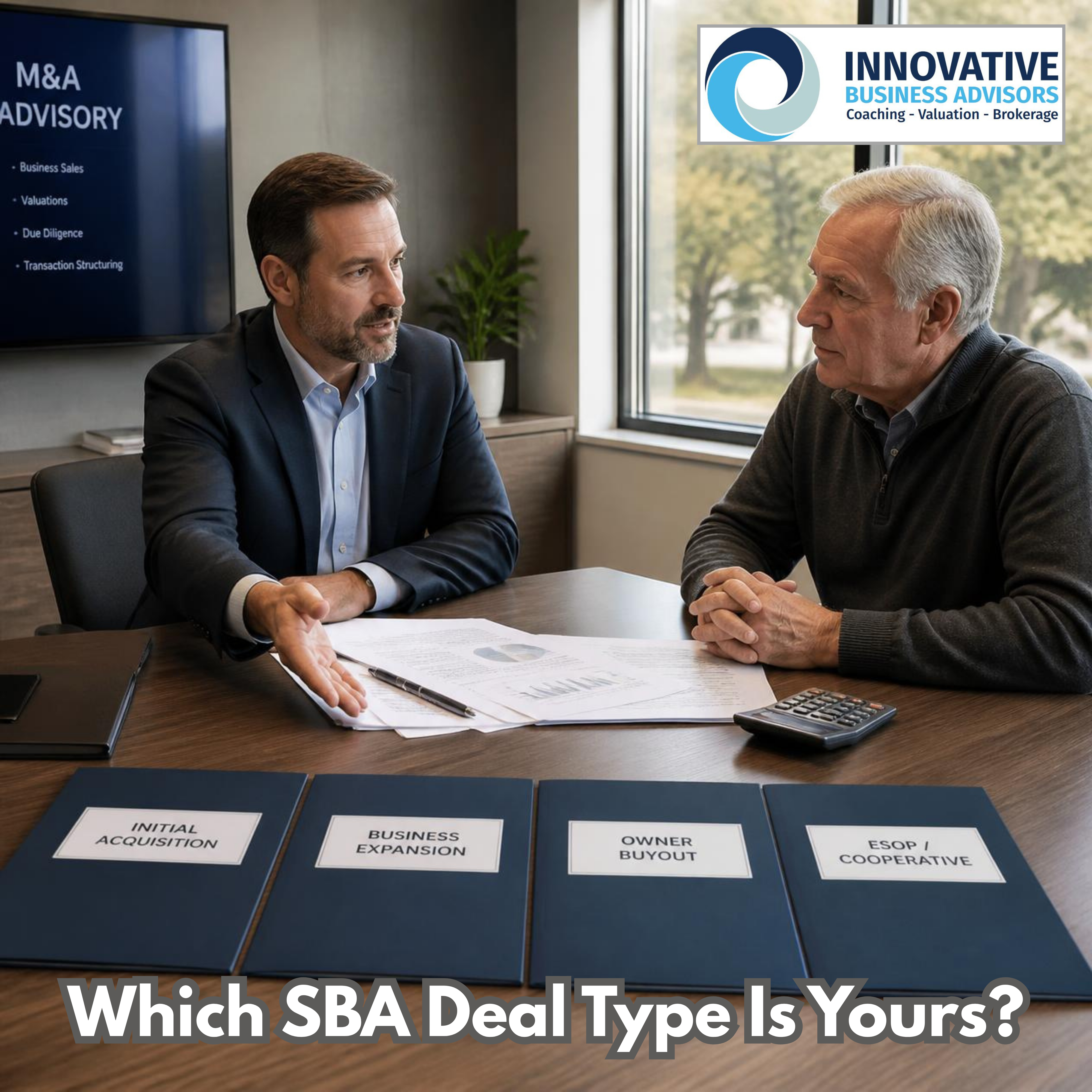
The SBA Just Created Four Categories for Business Sales — Which One Is Yours?
Starting October 1, 2026, the SBA requires every business sale financed with a 7(a) loan to be classified into one of four categories: Initial Acquisition, Business Expansion, Owner Buyout, or ESOP & Cooperative. The category your deal falls into determines how much cash the buyer needs up front, what financial reports the bank must order, and how strong the earnings need to be to support the loan. If you are planning to sell your business, you need to understand which category your deal will land in — because it directly affects your sale price, your timeline, and your deal structure.
Key Takeaways
Every SBA-financed business sale must now be classified into one of four categories, and the lender must enter the category into the SBA Loan System.
Initial Acquisition is the default. The lender must document in writing why a deal qualifies for any other category.
The category determines the buyer’s minimum down payment, the required debt service coverage ratio, and the level of financial due diligence.
Business Expansion gets the most favorable terms — but only if the buyer has operated a similar business for at least two years.
Owner Buyouts have new guardrails for bringing in outside investors.
What Are the Four SBA Transaction Categories?
Starting October 1, 2026, the SBA’s updated lending rules (SOP 50 10 8.1) require every change of ownership financed with a 7(a) loan to be placed into one of four categories. Think of these categories as buckets. Each bucket has its own set of rules for how the bank handles the loan. The lender picks the bucket, documents the choice in the credit memo, and enters it into the SBA’s system.
This matters to you as a seller because the bucket your buyer’s deal lands in controls three things: how much money the buyer must bring to the table, how closely the bank will examine your books, and what earnings ratio the deal must hit. Same business, same buyer — but a different category can mean a different outcome.
Here is what each one means.
What Is an Initial Acquisition?
An Initial Acquisition is any deal where a new owner — someone who was not previously an employee or owner of the business — ends up as the majority or largest individual owner. This is the most common type of business sale, and it is the default category. If the lender cannot document that the deal fits into one of the other three buckets, it lands here.
Initial Acquisitions carry the strictest requirements. The buyer must put down at least 10% equity, and that requirement cannot be reduced or waived. The deal must show a debt service coverage ratio of 1.25:1 — meaning the business must earn $1.25 for every $1.00 of debt payments. And if the purchase price is $3 million or more, the bank must order both an independent business valuation and a Quality of Earnings report.
If you are selling your business to someone who does not already own a piece of it and is not already working there, this is almost certainly where your deal will land.
What Is a Business Expansion?
A Business Expansion is when an existing operating business purchases another business. This is not someone buying their first company — it is an owner who already runs a business adding a second one.
To qualify, three conditions must be met:
- The buyer’s existing business must have been operating for at least two full fiscal years under its current ownership.
- The business being acquired must be in the same four-digit NAICS industry group as the buyer’s existing business.
- And the deal must result in the same number (or more) of full personal guarantors as existed before the transaction.
Why does this matter? Because Business Expansion gets the most favorable treatment. The debt service coverage ratio is 1.15:1 instead of 1.25:1, and the lender has the ability to reduce or even eliminate the 10% equity requirement if the buyer has strong liquidity and working capital. The buyer’s balance sheet must not show negative net worth at the last fiscal year-end.
If you are selling to a competitor, a company in your industry, or a strategic buyer who already runs a similar operation, this is the category you want the deal to qualify for. It gives the buyer the most room.
What Is an Owner Buyout?
An Owner Buyout is a deal that changes the ownership structure of the business without acquiring a different company. At least one original owner must remain in place after the transaction and personally guarantee the loan.
There are two types.
- Existing Owner Buyout is a transaction between current owners — one partner buying out another. Both the business and the acquiring owner must be co-borrowers on the loan.
- Partial Change of Ownership is when a new person buys some or all of a departing owner’s interest while at least one original owner stays. Under the new rules, the operating company and every new owner must be co-borrowers, no matter how small their stake. Even a 1% ownership interest triggers the co-borrower requirement.
The SBA added an important guardrail here. Any individual who is not currently employed by the business may only acquire less than 50% of the total equity and may not become the largest shareholder. If they would, the deal must be processed as an Initial Acquisition instead — with the stricter requirements that come with it.
Owner Buyouts require a debt service coverage ratio of 1.25:1. The baseline equity injection is 10%, but like Business Expansion, the lender may reduce or eliminate it if the buyer’s financial position supports it.
What About ESOPs and Cooperatives?
The fourth category covers sales to Employee Stock Ownership Plans (ESOPs) and cooperatives. These transactions have their own set of rules because the ownership structure is different — the employees collectively become the owners.
For most lower middle market business owners in Missouri and Illinois, this category is less common. But if you have explored selling to your employees, be aware that the debt service coverage requirement here is 1.25:1, and there is a federal statute requiring that if a seller stays on as a partial owner in an ESOP, they must provide a full, unlimited personal guarantee. That statutory requirement cannot be waived.
How Does the Category Affect My Sale?
The category drives three numbers that shape every deal.
- Equity injection — how much cash the buyer needs. Initial Acquisitions are locked at 10% with no relief. Business Expansions and Owner Buyouts start at 10% but can go lower. This directly affects how many buyers can afford your business.
- Debt service coverage — how strong the earnings must be relative to the loan payments. At 1.25:1, the business must earn 25% more than its total debt obligations. At 1.15:1 (Business Expansion only), it must earn 15% more. A lower ratio supports a higher loan amount on the same earnings.
- Financial due diligence — what reports the bank must order before approving the loan. Every category requires an independent business valuation. Deals at $3 million and above in the Initial Acquisition and Business Expansion categories also require a Quality of Earnings report. We will cover these requirements in detail in our next post.
What Should I Do Now?
If you are thinking about selling your business in the next one to three years, start by understanding which category your most likely buyer falls into. A first-time buyer with no prior ownership experience puts you in Initial Acquisition territory. A competitor or industry buyer may qualify as a Business Expansion. A partner buyout is an Owner Buyout.
The category is not something you choose — it is determined by the facts of the transaction. But knowing where your deal will land helps you plan your asking price, your deal structure, and the kind of buyer you market to.
Talk to your M&A advisor and your lender early. The rules are clear, and planning around them is far easier than discovering them at the closing table.
Frequently Asked Questions
Can the seller choose which category applies? No. The category is determined by the facts of the transaction — who the buyer is, whether they already own a business, and how the deal is structured. The lender documents the classification in their credit memorandum.
What if my buyer could qualify for more than one category? Initial Acquisition is the default. The lender must document in writing why a deal qualifies as anything else. If the lender cannot make the case, the deal is processed as an Initial Acquisition.
Does the category affect the interest rate on the loan? No. Interest rate rules are set separately and apply across all categories. The category affects equity, debt service coverage, and financial due diligence requirements.
When do these rules take effect? These rules apply to any 7(a) loan application that receives an SBA loan number on or after October 1, 2026. Applications already submitted before that date are handled under the previous rules (as of August 2026).
This post is part of a four-part series on the SBA’s new lending rules effective October 1, 2026. Up next: what the new financial due diligence requirements mean for your business sale.
The information in this post is based on SBA SOP 50 10 8.1. It is general information, not legal, tax, or lending advice. Consult your M&A advisor, lender, and legal counsel about your specific situation.
Read More
Truth #12: Selling Your Business in 2026 – What It’s Really Worth
From the Series 12 Brutal Truths About Selling a $5–50M Business in 2026 And How to Protect Your Life’s Work
Your business is worth what a prepared buyer is willing to pay based on risk, growth, industry demand, and structure — not just revenue. Preparation over the next 12–36 months can significantly increase value.
If your company generates between $5 million and $50 million annually, you may be asking: How much is my business worth in 2026?
The answer isn’t found in headlines. It depends on how buyers view your business today — and how prepared you are.
Why General Market Trends Aren’t Enough
Yes, the 2026 M&A market is active. Yes, private equity and strategic buyers are still acquiring strong companies. But general trends don’t determine your valuation. Buyers underwrite risk at the company level — not the headline level.
What Actually Determines Your Business Value
Five core factors drive valuation:
- Financial Performance – Consistency of EBITDA, margin strength, and quality of earnings.
- Industry Dynamics – Consolidation trends, competitive positioning, and growth outlook.
- Management & Succession – Depth beyond the owner. Buyers discount owner-dependent businesses.
- Risk Profile – Customer concentration, revenue predictability, and operational systems.
- Timing & Personal Goals – Structure matters. Earn-outs, phased transitions, or clean exits affect total value.
How Buyers Will Evaluate Your Company in 2026
Buyers will ask:
Can this business grow without the current owner?
Are earnings defensible?
What risks justify a lower multiple?
Where is the upside?
The same market that punishes unprepared sellers rewards those who prepare strategically. Valuation isn’t determined by revenue, it’s determined by risk.
The 12–36 Month Exit Readiness Roadmap
If you plan to sell within the next 1–5 years:
Conduct a buyer-perspective review today
Identify valuation gaps
Strengthen management depth
Improve margin consistency
Reduce concentration risk
Document systems and processes
Preparation creates leverage. Leverage creates value.
Frequently Asked Questions
How much is my business worth in 2026? It depends on EBITDA, growth potential, industry demand, and risk profile. Multiples vary widely based on buyer perception and readiness.
Should I sell my business in 2026? The better question is whether your business is prepared to command premium valuation. Timing matters less than preparation.
What is exit planning for business owners? Exit planning is the 12–36 month process of strengthening financial, operational, and structural elements before going to market.
Final Thought
Don’t go into a transition process unprepared. The difference between a discounted sale and a premium exit often comes down to 12–24 months of intentional preparation.
If you own a business generating $50M or less and want clarity — not hype — about what your company could be worth:
👉 Schedule a free confidential valuation strategy conversation: link.stlbusinessbrokers.com/widget/bookings/steve-denny
No cost. No obligation. Just insight specific to your situation.
Read More

Truth #11: Life After Selling Your Business – Protect What Matters Most
From the Series 12 Brutal Truths About Selling a $5–50M Business in 2026 And How to Protect Your Life’s Work
If you’re selling a $5–50M business in 2026, the biggest risks aren’t just financial. Protecting your employees, your legacy, and your identity requires intentional planning — and the right buyer.
If your company generates between $5 million and $50 million annually, the 2026 M&A market is already shaping three critical outcomes:
Who will buy your company
What they’ll pay
How much control you’ll retain
But the deeper question most owners wrestle with isn’t valuation. It’s this:
What happens to my life after selling my business?
Why Selling Your Business Is About More Than Money
For most founders, this is never just a transaction.
It’s years of relationships.
Reputation.
Responsibility.
The real questions sound like:
What happens to my employees after the sale?
Will the name and culture we built survive?
Who am I once I’m no longer “the owner”?
Ignoring those questions doesn’t make them disappear. Addressing them early strengthens your negotiating position.
What Happens to Your Employees After the Sale?
In today’s M&A environment, you have more leverage than you think.
You can:
Screen buyers for cultural alignment
Negotiate employment protections for key team members
Structure retention bonuses
Create phased leadership transitions
Secure defined roles during transition periods
Private equity buyers and strategic acquirers evaluate culture differently. Understanding that distinction gives you leverage.
If protecting employees in a sale matters to you, it must be part of the strategy — not an afterthought.
How to Protect Your Legacy in a Business Sale
Legacy planning for business owners is about intentional buyer selection.
That includes:
Cultural due diligence
Alignment on growth vision
Agreement on brand preservation
Clear communication strategy post-close
“Don’t just sell your company. Buy the buyer.” The right structure protects what you built. The wrong one erodes it quietly.
Who Are You After You’re No Longer the Owner?
Identity transition is the most underestimated risk in a $5–50M exit.
Some owners thrive.
Some drift.
Designing your post-sale life matters as much as negotiating your earn-out.
Consider:
Advisory roles
Board participation
Philanthropy
New ventures
Family transition planning
Clarity prevents regret.
Frequently Asked Questions
What is life after selling your business like?
It involves transitioning ownership while redefining your identity, protecting employees, and preserving your legacy through structured agreements.
Can I protect my employees during a sale?
Yes. Through negotiated employment agreements, retention bonuses, and buyer screening for cultural alignment.
Is 2026 a good time to sell a $5–50M business?
Industry consolidation and private equity activity remain strong, but preparation determines outcomes more than timing alone.
Final Thought
Price matters.
But peace of mind matters more.
If you own a business generating $50M or less and want clarity — not hype — about how today’s M&A environment affects your company and your future:
👉 Schedule a confidential conversation about your exit options:
link.stlbusinessbrokers.com/widget/bookings/steve-denny
No cost. No obligation. Just insight tailored to your situation.
Read More