
Selling Your Business? The SBA Just Changed How Long You Can Stay Involved
The SBA’s updated lending rules make three changes that directly affect what happens to the seller after a business sale closes. First, the time a seller can stay on as a paid consultant doubles from 12 months to 24 months. Second, in a partial change of ownership, the seller can now remain in essentially any role — owner, officer, director, stockholder, key employee, or employee. Third, a seller who keeps less than 20% ownership after the sale must provide a full personal guarantee of the full loan amount for at least two years. These changes give sellers more room to help with transitions while creating clearer obligations when they retain a stake.
Key Takeaways
 The seller’s consulting transition period doubles from 12 months to 24 months for Initial Acquisition and Business Expansion deals.
In a Partial Change of Ownership, the seller may stay on as an owner, officer, director, stockholder, Key Employee, or employee.
A selling owner who retains less than 20% ownership post-sale must personally guarantee the full loan amount for a minimum of two years after final disbursement.
These two-year guarantors are not required to pledge their personal residence or other personal assets in the event of a collateral shortfall.
Can Sellers Stay Involved After the Sale?
Yes — and under the new rules, they can stay involved longer than before. Starting October 1, 2026, the SBA doubles the time a seller can serve as a paid consultant to the business from 12 months to 24 months, including any extensions.
This is a meaningful change. Under the previous rules, a 12-month window was often too short for a smooth transition, especially in businesses where the seller held key customer relationships, managed complex operations, or had specialized knowledge that could not be transferred quickly. Buyers often wanted more time with the seller. Sellers often wanted to help. The rules said no.
Now the window is 24 months. That gives both sides more room to plan a real transition — one where the seller can train the buyer, introduce them to key customers and vendors, and step back gradually instead of abruptly.
There is an important distinction, though. This 24-month consulting window applies to Initial Acquisitions and Business Expansions — deals where the seller is leaving the business entirely. The seller is engaged as an independent consultant, not as an employee. They cannot remain as an officer, director, stockholder, or employee of the business in these transaction types.
What If the Seller Wants to Keep a Role in the Business?
If the deal is structured as a Partial Change of Ownership — where at least one original owner stays and a new owner is buying in — the seller has much more flexibility.
Under the new rules, a seller in a partial change of ownership may remain in any of the following roles:
Owner
Officer
Director
Stockholder
Key Employee
Employee
This is a broad list. It means the seller can keep running the business, stay on the board, continue managing day-to-day operations, or take a reduced role — whatever makes sense for the transition and the buyer’s needs.
This flexibility applies because, in a partial change of ownership, the seller is not fully exiting. They are staying involved, and the SBA recognizes that their continued participation can help the business succeed. The remaining owner must stay on as a guarantor of the loan, which gives the lender comfort that the seller has ongoing financial exposure and incentive to support the business.
What Is the Guarantee Requirement for Sellers Who Keep a Small Stake?
This is the provision that sellers need to understand clearly. Under the new rules, a selling owner who retains less than 20% ownership in the business after the sale must provide a full personal guarantee of the full loan amount for a minimum of two years after final loan disbursement.
Let’s break that down in plain terms.
Say you own 100% of your business and you sell 85% to a buyer. You keep 15%. Under the new rules, you must personally guarantee the entire loan — not just 15% of it. And that guarantee stays in place for at least two years after the last loan funds are disbursed.
This guarantee is the bank’s protection. The SBA’s concern is that a seller who keeps a small stake might walk away from the business shortly after closing, leaving the buyer — and the bank — without the seller’s operational knowledge and customer relationships. By requiring a personal guarantee, the SBA ensures the seller has financial skin in the game during the critical post-closing period.
Does the Seller Have to Pledge Their Home?
No — and this is an important clarification that the SBA made in the new rules. A seller providing this two-year guarantee is not required to pledge their personal assets, including their personal residence, in the event of a collateral shortfall.
Under the previous rules, this was not always clear, and it was a common deal-killer. A seller who was otherwise willing to stay on with a small ownership stake would refuse to put their house on the line for the buyer’s loan. That refusal could blow up an otherwise workable deal.
The new rules draw a clear line. The guarantee is real — it covers the full loan amount for at least two years. But the SBA does not require the lender to go after the seller’s personal home or other personal property to satisfy a collateral gap. The lender may use SBA Form 148L or an equivalent form to document this limited-term guarantee.
How Does This Affect Deal Structures?
These three changes — the longer consulting window, the expanded roles in partial changes, and the two-year guarantee with no personal asset pledge — work together to give sellers and buyers more options.
For full sales (Initial Acquisition and Business Expansion): The seller exits but can consult for up to 24 months. This supports higher sale prices because buyers feel more confident they will have the seller’s help during the transition. A smoother handoff reduces the risk the buyer sees, and lower perceived risk supports a stronger offer.
For partial sales (Owner Buyout — Partial Change): The seller stays involved in whatever capacity makes sense. This is particularly valuable in family transitions, partnership restructurings, and deals where the seller wants to step back gradually rather than all at once. The seller keeps equity, keeps a role, and keeps influence — but they also keep the two-year guarantee obligation.
For deal negotiation: The guarantee requirement changes the conversation around retained equity. A seller keeping 19% faces a full personal guarantee of the full loan. A seller keeping 21% faces the standard guarantee rules, which are based on ownership percentage. That 20% line is now a key structuring decision, and sellers need to understand the trade-offs before they agree to a post-sale ownership level.
What Should Sellers Think About Now?
If you are planning to sell in the next one to three years, these changes affect how you think about three things.
- Your transition plan. Twenty-four months is a meaningful amount of time. If you have been worried about whether you can successfully hand off key relationships and operational knowledge, the new rules give you twice the runway. Use it. Build a transition plan that is realistic, not rushed.
- Your post-sale role. If you want to stay involved, consider whether a partial change of ownership makes sense for your situation. The flexibility to remain as an officer, director, or key employee may let you phase out gradually while protecting the business — and the buyer’s investment.
- Your guarantee If you plan to keep a small ownership stake, understand that anything below 20% triggers a full guarantee of the full loan amount for at least two years. That is a real obligation with real financial consequences. Make sure you are comfortable with it before you agree to the deal terms.
Talk to your M&A advisor about how these provisions interact with your specific deal structure. The right plan depends on your goals, your buyer, and the business itself.
Frequently Asked Questions
Can the two-year guarantee period be shorter than two years? No. The minimum is two years after final loan disbursement. The lender and seller may agree to a longer period, but not a shorter one.
Does the 24-month consulting window apply to Owner Buyouts? No. The 24-month consulting window applies to Initial Acquisitions and Business Expansions — deals where the seller is leaving the business. In a Partial Change of Ownership, the seller stays on in a formal role and the consulting provision does not apply.
What if the seller keeps exactly 20%? The two-year full-guarantee provision applies to sellers who retain less than 20%. At exactly 20% or above, the standard guarantee rules based on ownership percentage apply.
Can the seller be paid for their consulting services? Yes. The seller is engaged as an independent consultant and is compensated for their services. The terms of the consulting arrangement should be documented and at arm’s length.
When do these rules take effect? These provisions apply to any 7(a) loan application that receives an SBA loan number on or after October 1, 2026 (as of August 2026).
This is Part 3 of a four-part series on the SBA’s new lending rules effective October 1, 2026. Next: the full picture — what all of these changes mean for sellers, in one place.
The information in this post is based on SBA SOP 50 10 8.1. It is general information, not legal, tax, or lending advice. Consult your M&A advisor, lender, and legal counsel about your specific situation.
Read More
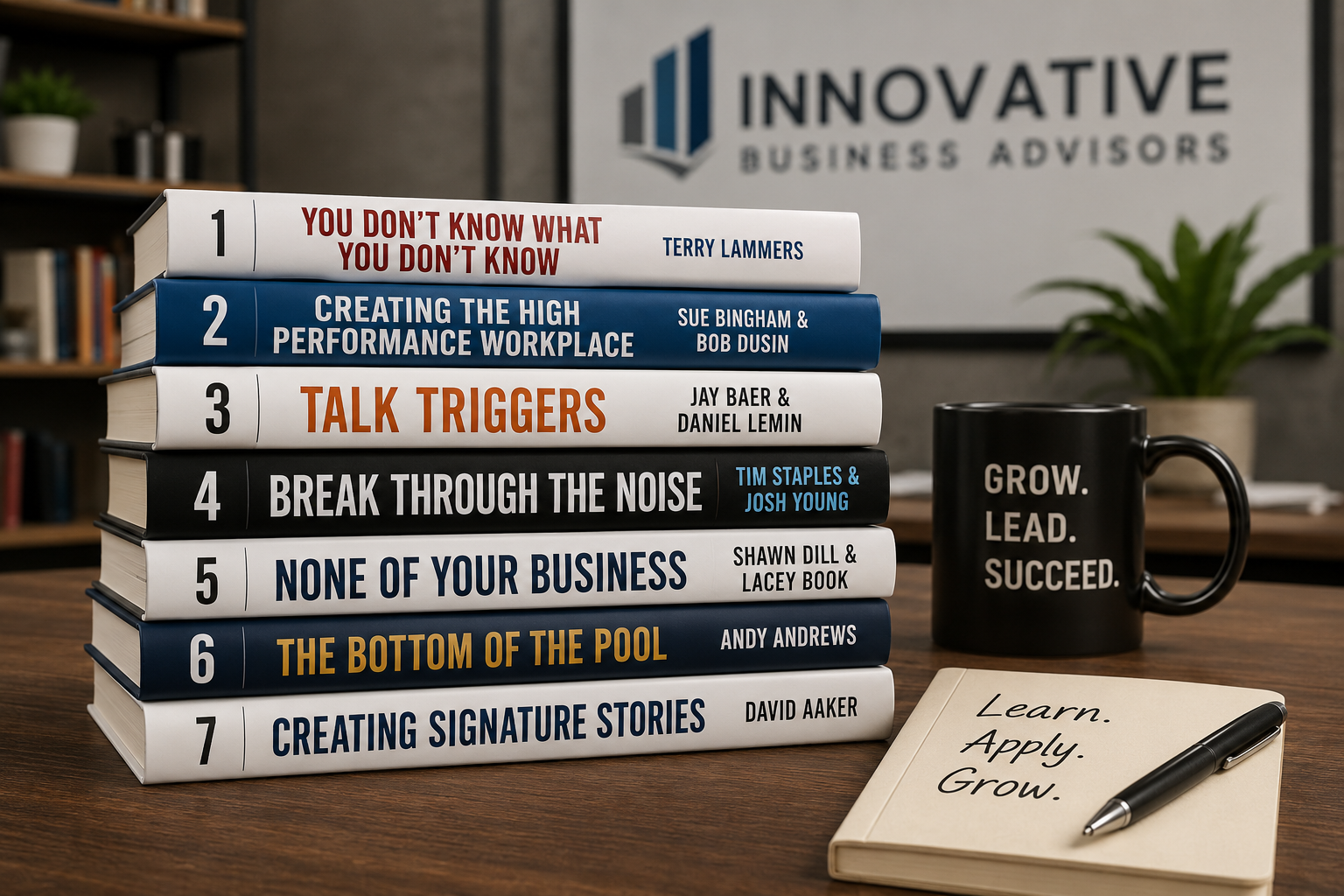
7 Must-Read Books That Will Help Entrepreneurs Grow Their Business
Every entrepreneur knows that scaling a business isn’t just about hard work — it’s about continuous learning. Successful founders absorb knowledge from every angle: leadership, marketing, strategy, and even merger-and-acquisition planning. That’s why reading the right books can be one of the smartest actions a business leader takes. In the Forbes article “The Best Books to Help Entrepreneurs Grow a Business,” top titles were curated to help business owners at every stage — from startup to expansion.
Here’s a closer look at those standout reads and why you should consider them for your next business-building bookshelf.
📖 1. You Don’t Know What You Don’t Know — Terry Lammers
Kicking off the Forbes list is You Don’t Know What You Don’t Know: Everything You Need to Know to Buy or Sell a Business by Terry Lammers—a distinction that speaks to both the relevance and impact of his work. Terry is not only the author of this highly regarded book, but is also the Managing Partner of Innovative Business Advisors.
In the book, Terry draws from decades of real-world experience helping business owners navigate growth, acquisitions, exit planning, and succession strategies. These are the same core areas where Innovative Business Advisors works closely with privately held companies—providing guidance on buying and selling businesses, business valuations, exit readiness, and strategic planning.
At Innovative, the mission is simple: help business owners maximize value and make informed decisions at every stage of ownership. You Don’t Know What You Don’t Know reflects that philosophy by shedding light on critical issues many entrepreneurs don’t realize they should be addressing until it’s too late. Whether an owner is years away from a transition or actively considering a sale, the insights in this book align directly with our advisory services.
The recognition of Terry’s book by Forbes reinforces the depth of experience and practical knowledge behind Innovative’s team—and why proactive planning can make a meaningful difference in the outcome of a business journey.
📘 2. Creating the High Performance Workplace — Sue Bingham & Bob Dusin
Growth isn’t possible without effective teams. Bingham and Dusin explore how to cultivate a workplace where employees act like owners — giving direction on fostering engagement, accountability, and a culture that fuels growth rather than resists change.
💡 3. Talk Triggers — Jay Baer & Daniel Lemin
Word-of-mouth still rules. Baer and Lemin show how to deliberately design customer experiences that people talk about, helping your business grow organically through referrals instead of expensive advertising.
📈 4. Break Through the Noise — Tim Staples & Josh Young
Standing out in today’s crowded digital landscape can feel impossible — but this book offers real strategies for boosting your brand visibility through smart online marketing, without breaking the bank.
💡 5. None of Your Business — Shawn Dill & Lacey Book
For many visionaries, the leap from dreamer to business builder is the hardest. Dill and Book bridge that gap by helping readers think like entrepreneurs, turning passion into profit with practical, actionable steps.
🎯 6. The Bottom of the Pool — Andy Andrews
Andrews challenges entrepreneurs to question long-held assumptions and comfort-zone thinking. This mindset shift can be a game-changer — innovation often begins where certainty ends.
📖 7. Creating Signature Stories — David Aaker
Strong brands are built on memorable narratives. Aaker’s guide teaches entrepreneurs why storytelling matters and how to craft stories that bring your business, mission, and values to life.
🚀 Why These Books Matter
Reading about business strategy is a great first step — but the real growth comes from applying what you learn with the right guidance and timing. The books highlighted in Forbes blend mindset, practical action, and real-world experience to help entrepreneurs:
Strengthen leadership and company culture,
Build brands that stand out,
Make smarter growth decisions, and
Prepare for major milestones such as acquisitions, succession planning, or an eventual sale.
At Innovative Business Advisors, these same principles are put into practice every day. We work alongside business owners to help them understand their company’s value, plan proactively for the future, and navigate complex transitions with clarity and confidence. Whether an owner is years away from an exit or simply wants to be better prepared for opportunities ahead, education paired with experienced advisory support can make all the difference.
For entrepreneurs inspired by the insights in these books, learning more about valuation, exit readiness, and strategic planning can be a natural next step. Contact us at info@innovativeba.com to learn more.
📌 Final Thought
Every entrepreneur’s journey is unique, but great books give you the advantage of learning from others who’ve walked the path before. Whether you’re just starting or aiming to grow your company to the next level, make these reads part of your strategy for success.
Read More

Truth #12: Selling Your Business in 2026 – What It’s Really Worth
From the Series 12 Brutal Truths About Selling a $5–50M Business in 2026 And How to Protect Your Life’s Work
Your business is worth what a prepared buyer is willing to pay based on risk, growth, industry demand, and structure — not just revenue. Preparation over the next 12–36 months can significantly increase value.
If your company generates between $5 million and $50 million annually, you may be asking: How much is my business worth in 2026?
The answer isn’t found in headlines. It depends on how buyers view your business today — and how prepared you are.
Why General Market Trends Aren’t Enough
Yes, the 2026 M&A market is active. Yes, private equity and strategic buyers are still acquiring strong companies. But general trends don’t determine your valuation. Buyers underwrite risk at the company level — not the headline level.
What Actually Determines Your Business Value
Five core factors drive valuation:
- Financial Performance – Consistency of EBITDA, margin strength, and quality of earnings.
- Industry Dynamics – Consolidation trends, competitive positioning, and growth outlook.
- Management & Succession – Depth beyond the owner. Buyers discount owner-dependent businesses.
- Risk Profile – Customer concentration, revenue predictability, and operational systems.
- Timing & Personal Goals – Structure matters. Earn-outs, phased transitions, or clean exits affect total value.
How Buyers Will Evaluate Your Company in 2026
Buyers will ask:
Can this business grow without the current owner?
Are earnings defensible?
What risks justify a lower multiple?
Where is the upside?
The same market that punishes unprepared sellers rewards those who prepare strategically. Valuation isn’t determined by revenue, it’s determined by risk.
The 12–36 Month Exit Readiness Roadmap
If you plan to sell within the next 1–5 years:
Conduct a buyer-perspective review today
Identify valuation gaps
Strengthen management depth
Improve margin consistency
Reduce concentration risk
Document systems and processes
Preparation creates leverage. Leverage creates value.
Frequently Asked Questions
How much is my business worth in 2026? It depends on EBITDA, growth potential, industry demand, and risk profile. Multiples vary widely based on buyer perception and readiness.
Should I sell my business in 2026? The better question is whether your business is prepared to command premium valuation. Timing matters less than preparation.
What is exit planning for business owners? Exit planning is the 12–36 month process of strengthening financial, operational, and structural elements before going to market.
Final Thought
Don’t go into a transition process unprepared. The difference between a discounted sale and a premium exit often comes down to 12–24 months of intentional preparation.
If you own a business generating $50M or less and want clarity — not hype — about what your company could be worth:
👉 Schedule a free confidential valuation strategy conversation: link.stlbusinessbrokers.com/widget/bookings/steve-denny
No cost. No obligation. Just insight specific to your situation.
Read More

Truth #11: Life After Selling Your Business – Protect What Matters Most
From the Series 12 Brutal Truths About Selling a $5–50M Business in 2026 And How to Protect Your Life’s Work
If you’re selling a $5–50M business in 2026, the biggest risks aren’t just financial. Protecting your employees, your legacy, and your identity requires intentional planning — and the right buyer.
If your company generates between $5 million and $50 million annually, the 2026 M&A market is already shaping three critical outcomes:
Who will buy your company
What they’ll pay
How much control you’ll retain
But the deeper question most owners wrestle with isn’t valuation. It’s this:
What happens to my life after selling my business?
Why Selling Your Business Is About More Than Money
For most founders, this is never just a transaction.
It’s years of relationships.
Reputation.
Responsibility.
The real questions sound like:
What happens to my employees after the sale?
Will the name and culture we built survive?
Who am I once I’m no longer “the owner”?
Ignoring those questions doesn’t make them disappear. Addressing them early strengthens your negotiating position.
What Happens to Your Employees After the Sale?
In today’s M&A environment, you have more leverage than you think.
You can:
Screen buyers for cultural alignment
Negotiate employment protections for key team members
Structure retention bonuses
Create phased leadership transitions
Secure defined roles during transition periods
Private equity buyers and strategic acquirers evaluate culture differently. Understanding that distinction gives you leverage.
If protecting employees in a sale matters to you, it must be part of the strategy — not an afterthought.
How to Protect Your Legacy in a Business Sale
Legacy planning for business owners is about intentional buyer selection.
That includes:
Cultural due diligence
Alignment on growth vision
Agreement on brand preservation
Clear communication strategy post-close
“Don’t just sell your company. Buy the buyer.” The right structure protects what you built. The wrong one erodes it quietly.
Who Are You After You’re No Longer the Owner?
Identity transition is the most underestimated risk in a $5–50M exit.
Some owners thrive.
Some drift.
Designing your post-sale life matters as much as negotiating your earn-out.
Consider:
Advisory roles
Board participation
Philanthropy
New ventures
Family transition planning
Clarity prevents regret.
Frequently Asked Questions
What is life after selling your business like?
It involves transitioning ownership while redefining your identity, protecting employees, and preserving your legacy through structured agreements.
Can I protect my employees during a sale?
Yes. Through negotiated employment agreements, retention bonuses, and buyer screening for cultural alignment.
Is 2026 a good time to sell a $5–50M business?
Industry consolidation and private equity activity remain strong, but preparation determines outcomes more than timing alone.
Final Thought
Price matters.
But peace of mind matters more.
If you own a business generating $50M or less and want clarity — not hype — about how today’s M&A environment affects your company and your future:
👉 Schedule a confidential conversation about your exit options:
link.stlbusinessbrokers.com/widget/bookings/steve-denny
No cost. No obligation. Just insight tailored to your situation.
Read More

Truth #10: Why Buyers Price Risk Before Earnings When Selling a $5–50M Business
From the Series 12 Brutal Truths About Selling a $5–50M Business in 2026 And How to Protect Your Life’s Work
If your business generates between $5 million and $50 million in annual revenue, the 2026 M&A market is already forming an opinion about your company.
That opinion shapes:
Who can buy your business
What they’re willing to pay
How the deal will be structured
And long before buyers debate valuation multiples, they ask a more basic question:
How risky is this business?
When selling a $5–50M business, buyers price risk first and earnings second. The more risk they see, the more they discount value, add contingencies, or walk away.
Truth #10: Buyers Price Your Risk Before They Price Your Company
From a buyer’s perspective, valuation is not just about earnings—it’s about certainty.
Strong earnings with high risk don’t command premium prices. Predictable earnings with low risk do.
This is why two businesses with similar EBITDA can sell at very different valuations.
How Buyers Think About Risk in M&A
Buyers assess risk across several dimensions. The most common include:
- Owner Dependence Risk – If the business relies heavily on you, buyers worry about what happens when you exit. Businesses that can’t run independently are harder to value—and harder to finance.
- Customer Concentration Risk – If losing one customer could materially hurt the business, buyers price that exposure into the deal through lower multiples or contingent payments.
- Key Employee Risk – When critical knowledge or relationships live with one or two employees, buyers see fragility—not scalability.
- Process and Systems Risk – If performance depends on personalities instead of processes, buyers question whether results are repeatable.
How Risk Impacts Valuation and Deal Terms
The more risk buyers perceive, the more they protect themselves.
That usually means they:
- Reduce valuation multiples
- Demand earn-outs or seller financing
- Increase diligence requirements
- Slow the process—or walk away
Risk doesn’t just affect price. It affects certainty of close.
Why Reducing Risk Increases Buyer Demand
Businesses with predictable revenue, documented processes, diversified customers, and strong management teams attract:
More buyers
Better financing
Cleaner deal structures
Reducing risk is good for your sanity while you own the business—and good for your valuation when you sell.
What Owners Can Do to Reduce Risk Before Selling
Owners who plan ahead can materially improve outcomes by:
Building management depth
Documenting processes
Reducing customer concentration
Improving reporting and predictability
Stress-testing the business without the owner
These changes don’t just help at exit—they strengthen the business today.
Final Thought
If you want to maximize value, don’t just grow earnings.
Reduce risk.
Because buyers don’t pay top dollar for earnings they can’t trust.
A Smarter Next Step
If you own a business generating $50 million or less in annual revenue and want clarity—not hype—about how buyers would view your risk profile:
👉 Schedule a confidential, no-obligation conversation about your business, your goals, and your exit options at the link below.
https://link.stlbusinessbrokers.com/widget/bookings/sdennybizinquiry
No cost.
No pressure.
Just a focused discussion on your situation.