





When Should You Start Planning Your Business Exit? Earlier Than You Think
Most business owners know they should eventually plan for leaving their business. Far fewer actually put a plan in place.
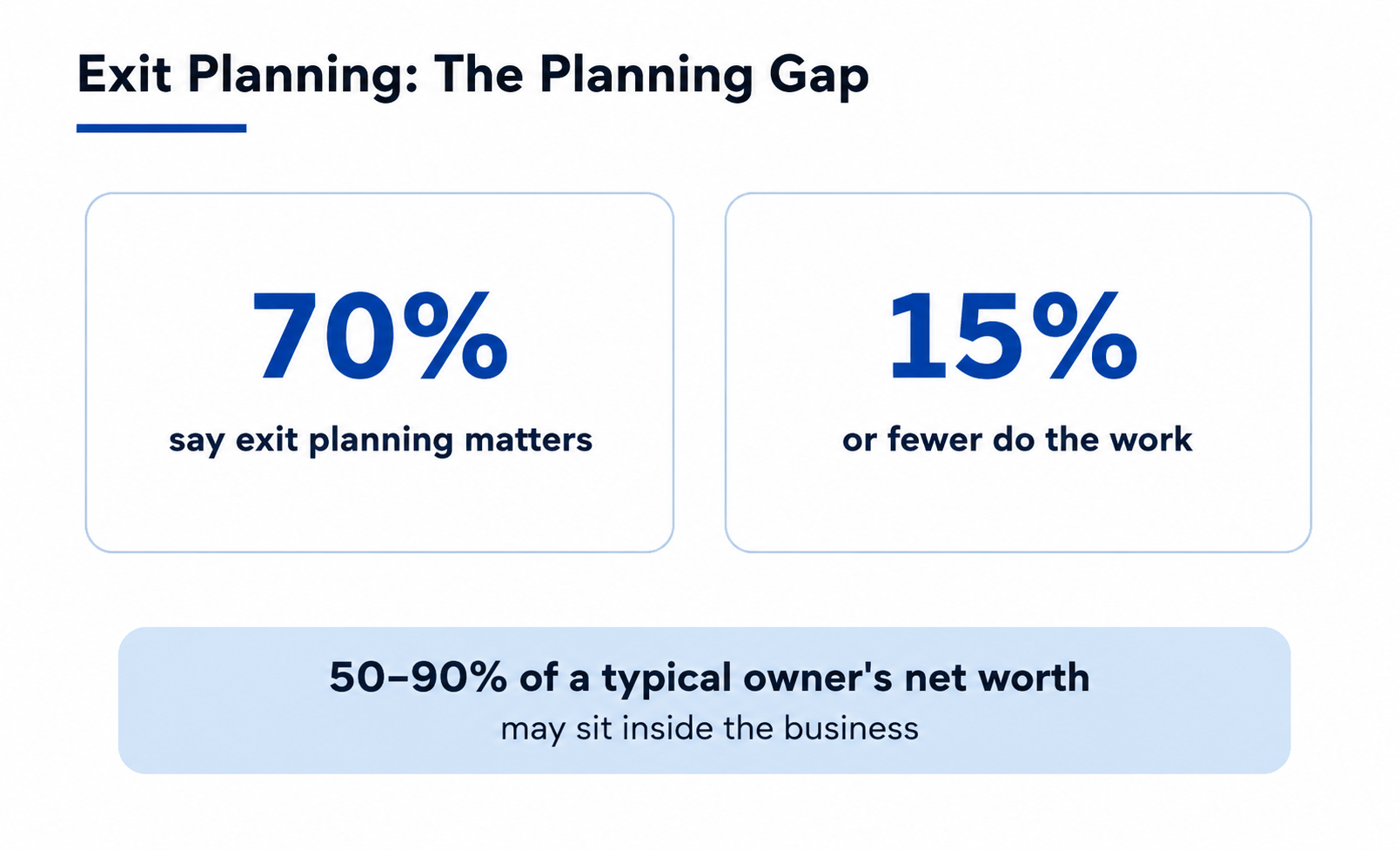
Approximately 70% of business owners say exit planning matters, yet 15% or fewer actually do the work. That’s especially significant when an estimated 50% to 90% of a typical owner’s net worth may be tied up in the business.
For many owners, the business isn’t just a career. It’s the retirement account.
So when should exit planning begin?
Start at Least Two to Three Years Before You Expect to Exit
Ideally, business owners should begin serious exit planning at least two to three years before their target exit date.
In some cases, five years or more may be necessary.
That time gives you an opportunity to:
Obtain a formal business valuation
Review your business and entity structure
Clean up financial statements
Address weaknesses that could affect value
Assemble an experienced advisory team
Consider tax, estate and charitable strategies
Prepare yourself and your family for what comes next
Certain decisions simply can’t be made at the last minute. For example, some entity restructuring decisions may require years of advance planning.
Waiting until a buyer approaches you can mean discovering that some of your best options are no longer available.
“Three to Five Years” Isn’t a Plan
Ask business owners when they expect to exit, and there’s a common response:
“The answer is always three to five years. And it happens every year — three to five years.”
— Ryan, Trinity Wealth Advisors
Three to five years from now can easily become three to five years from now again next year.
The first step toward creating a real exit plan is simple:
Put a date on the calendar.
It doesn’t mean you’re obligated to sell on that date. It gives you a target that allows you and your advisors to work backward and identify what needs to happen along the way.
Pay Attention to What Your Business Is Telling You
Your target date isn’t the only reason to start planning.
Sometimes the business begins signaling that it’s time.
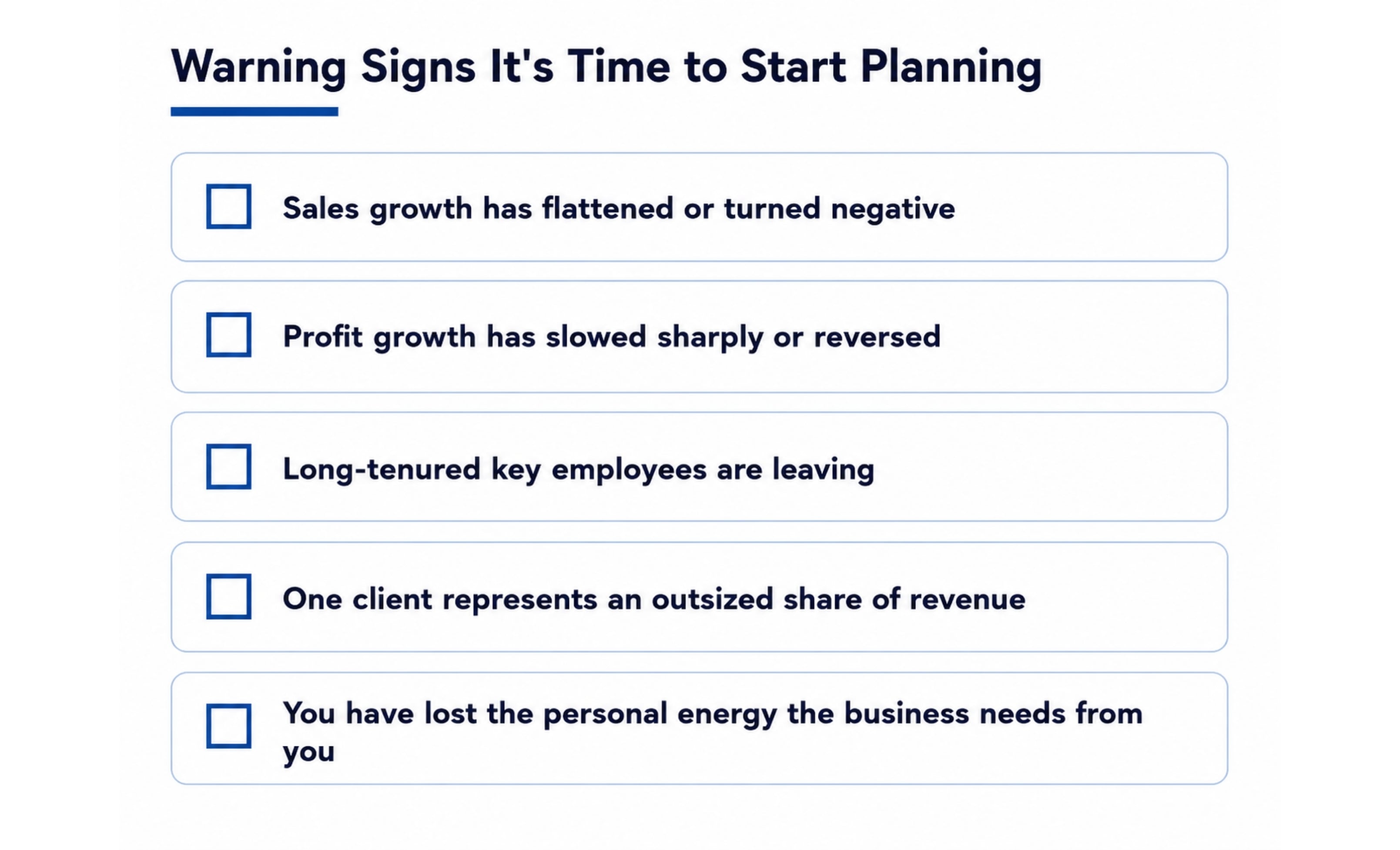
Sales growth may flatten. Profits may begin declining. Long-tenured employees may start leaving. Or you may realize that you no longer have the same energy and enthusiasm for running the company.
“A stagnant business is not where you want to be. You don’t want to swim in a pool of stagnant water.”
— Steve Denny, Innovative Business Advisors
Those warning signs don’t necessarily mean you should immediately sell.
They mean it’s time to understand your options.
Build Your Exit Planning Team Before You Need It
Exit planning isn’t something one advisor should handle alone.
Depending on your circumstances, your team may include:
An M&A advisor
A business valuation professional
A CPA experienced in business transitions
An M&A or transactional attorney
A wealth advisor
An estate-planning professional
Experience with actual business transactions matters.
Ask your CPA how frequently they work on business transitions. Ask your attorney how frequently they handle M&A transactions.
“There are estate planning attorneys and there are transactional attorneys. You need an attorney who is used to doing M&A transactions — the wrong one can be detrimental to the deal.”
— Terry Lammers, Certified Valuation Analyst and Partner, Innovative Business Advisors
You don’t want your business sale to be someone’s opportunity to learn how business sales work.
Work Backward From Your Target Date
A simple planning timeline might look like this:
Five Years Out
Review entity structure and any decisions that may require a lengthy tax seasoning period.
Two to Three Years Out
Obtain a formal valuation, assemble your advisory team, clean up your financials and begin addressing factors that could reduce business value.
Twelve Months Out
Finalize transaction-related tax planning and evaluate charitable gifts, employee bonuses and other strategies that may need to occur before a business is under agreement.
Approaching the Sale
Review the potential tax consequences of the transaction and make sure you’re prepared financially and personally for the transition.
The important point isn’t that every owner will follow exactly the same timeline.
It’s that time creates options.
The Goal Isn’t Just a Higher Selling Price
It’s easy to think exit planning is about getting the highest possible offer.
That’s only part of the equation.
“The selling price is one thing. At the end of the day, what matters most is how much you get to keep.”
— Steve Denny, M&A Advisor and Co-Founder, Innovative Business Advisors
The earlier you begin planning, the more opportunities you may have to increase value, address risks, structure the transaction appropriately and protect the wealth you’ve spent decades creating.
You don’t need to be ready to sell to start planning.
You simply need to be ready to understand your options.
Coming Next
Part 2: Is Your Business Ready to Sell? How to Strengthen the Company Before an Exit
We’ll look at three issues that can significantly affect a future transaction: customer concentration, business structure and financial cleanup.
This article is part of our five-part business exit planning series based on insights shared during a webinar featuring Steve Denny of Innovative Business Advisors and Jim Matush and Ryan Wagner of Trinity Wealth Advisors. To hear the complete conversation and additional insights from Steve, Jim and Ryan, watch the full webinar replay on YouTube.

Read More

Truth #12: Selling Your Business in 2026 – What It’s Really Worth
From the Series 12 Brutal Truths About Selling a $5–50M Business in 2026 And How to Protect Your Life’s Work
Your business is worth what a prepared buyer is willing to pay based on risk, growth, industry demand, and structure — not just revenue. Preparation over the next 12–36 months can significantly increase value.
If your company generates between $5 million and $50 million annually, you may be asking: How much is my business worth in 2026?
The answer isn’t found in headlines. It depends on how buyers view your business today — and how prepared you are.
Why General Market Trends Aren’t Enough
Yes, the 2026 M&A market is active. Yes, private equity and strategic buyers are still acquiring strong companies. But general trends don’t determine your valuation. Buyers underwrite risk at the company level — not the headline level.
What Actually Determines Your Business Value
Five core factors drive valuation:
- Financial Performance – Consistency of EBITDA, margin strength, and quality of earnings.
- Industry Dynamics – Consolidation trends, competitive positioning, and growth outlook.
- Management & Succession – Depth beyond the owner. Buyers discount owner-dependent businesses.
- Risk Profile – Customer concentration, revenue predictability, and operational systems.
- Timing & Personal Goals – Structure matters. Earn-outs, phased transitions, or clean exits affect total value.
How Buyers Will Evaluate Your Company in 2026
Buyers will ask:
Can this business grow without the current owner?
Are earnings defensible?
What risks justify a lower multiple?
Where is the upside?
The same market that punishes unprepared sellers rewards those who prepare strategically. Valuation isn’t determined by revenue, it’s determined by risk.
The 12–36 Month Exit Readiness Roadmap
If you plan to sell within the next 1–5 years:
Conduct a buyer-perspective review today
Identify valuation gaps
Strengthen management depth
Improve margin consistency
Reduce concentration risk
Document systems and processes
Preparation creates leverage. Leverage creates value.
Frequently Asked Questions
How much is my business worth in 2026? It depends on EBITDA, growth potential, industry demand, and risk profile. Multiples vary widely based on buyer perception and readiness.
Should I sell my business in 2026? The better question is whether your business is prepared to command premium valuation. Timing matters less than preparation.
What is exit planning for business owners? Exit planning is the 12–36 month process of strengthening financial, operational, and structural elements before going to market.
Final Thought
Don’t go into a transition process unprepared. The difference between a discounted sale and a premium exit often comes down to 12–24 months of intentional preparation.
If you own a business generating $50M or less and want clarity — not hype — about what your company could be worth:
👉 Schedule a free confidential valuation strategy conversation: link.stlbusinessbrokers.com/widget/bookings/steve-denny
No cost. No obligation. Just insight specific to your situation.
Read More

Truth #11: Life After Selling Your Business – Protect What Matters Most
From the Series 12 Brutal Truths About Selling a $5–50M Business in 2026 And How to Protect Your Life’s Work
If you’re selling a $5–50M business in 2026, the biggest risks aren’t just financial. Protecting your employees, your legacy, and your identity requires intentional planning — and the right buyer.
If your company generates between $5 million and $50 million annually, the 2026 M&A market is already shaping three critical outcomes:
Who will buy your company
What they’ll pay
How much control you’ll retain
But the deeper question most owners wrestle with isn’t valuation. It’s this:
What happens to my life after selling my business?
Why Selling Your Business Is About More Than Money
For most founders, this is never just a transaction.
It’s years of relationships.
Reputation.
Responsibility.
The real questions sound like:
What happens to my employees after the sale?
Will the name and culture we built survive?
Who am I once I’m no longer “the owner”?
Ignoring those questions doesn’t make them disappear. Addressing them early strengthens your negotiating position.
What Happens to Your Employees After the Sale?
In today’s M&A environment, you have more leverage than you think.
You can:
Screen buyers for cultural alignment
Negotiate employment protections for key team members
Structure retention bonuses
Create phased leadership transitions
Secure defined roles during transition periods
Private equity buyers and strategic acquirers evaluate culture differently. Understanding that distinction gives you leverage.
If protecting employees in a sale matters to you, it must be part of the strategy — not an afterthought.
How to Protect Your Legacy in a Business Sale
Legacy planning for business owners is about intentional buyer selection.
That includes:
Cultural due diligence
Alignment on growth vision
Agreement on brand preservation
Clear communication strategy post-close
“Don’t just sell your company. Buy the buyer.” The right structure protects what you built. The wrong one erodes it quietly.
Who Are You After You’re No Longer the Owner?
Identity transition is the most underestimated risk in a $5–50M exit.
Some owners thrive.
Some drift.
Designing your post-sale life matters as much as negotiating your earn-out.
Consider:
Advisory roles
Board participation
Philanthropy
New ventures
Family transition planning
Clarity prevents regret.
Frequently Asked Questions
What is life after selling your business like?
It involves transitioning ownership while redefining your identity, protecting employees, and preserving your legacy through structured agreements.
Can I protect my employees during a sale?
Yes. Through negotiated employment agreements, retention bonuses, and buyer screening for cultural alignment.
Is 2026 a good time to sell a $5–50M business?
Industry consolidation and private equity activity remain strong, but preparation determines outcomes more than timing alone.
Final Thought
Price matters.
But peace of mind matters more.
If you own a business generating $50M or less and want clarity — not hype — about how today’s M&A environment affects your company and your future:
👉 Schedule a confidential conversation about your exit options:
link.stlbusinessbrokers.com/widget/bookings/steve-denny
No cost. No obligation. Just insight tailored to your situation.
Read More

Truth #10: Why Buyers Price Risk Before Earnings When Selling a $5–50M Business
From the Series 12 Brutal Truths About Selling a $5–50M Business in 2026 And How to Protect Your Life’s Work
If your business generates between $5 million and $50 million in annual revenue, the 2026 M&A market is already forming an opinion about your company.
That opinion shapes:
Who can buy your business
What they’re willing to pay
How the deal will be structured
And long before buyers debate valuation multiples, they ask a more basic question:
How risky is this business?
When selling a $5–50M business, buyers price risk first and earnings second. The more risk they see, the more they discount value, add contingencies, or walk away.
Truth #10: Buyers Price Your Risk Before They Price Your Company
From a buyer’s perspective, valuation is not just about earnings—it’s about certainty.
Strong earnings with high risk don’t command premium prices. Predictable earnings with low risk do.
This is why two businesses with similar EBITDA can sell at very different valuations.
How Buyers Think About Risk in M&A
Buyers assess risk across several dimensions. The most common include:
- Owner Dependence Risk – If the business relies heavily on you, buyers worry about what happens when you exit. Businesses that can’t run independently are harder to value—and harder to finance.
- Customer Concentration Risk – If losing one customer could materially hurt the business, buyers price that exposure into the deal through lower multiples or contingent payments.
- Key Employee Risk – When critical knowledge or relationships live with one or two employees, buyers see fragility—not scalability.
- Process and Systems Risk – If performance depends on personalities instead of processes, buyers question whether results are repeatable.
How Risk Impacts Valuation and Deal Terms
The more risk buyers perceive, the more they protect themselves.
That usually means they:
- Reduce valuation multiples
- Demand earn-outs or seller financing
- Increase diligence requirements
- Slow the process—or walk away
Risk doesn’t just affect price. It affects certainty of close.
Why Reducing Risk Increases Buyer Demand
Businesses with predictable revenue, documented processes, diversified customers, and strong management teams attract:
More buyers
Better financing
Cleaner deal structures
Reducing risk is good for your sanity while you own the business—and good for your valuation when you sell.
What Owners Can Do to Reduce Risk Before Selling
Owners who plan ahead can materially improve outcomes by:
Building management depth
Documenting processes
Reducing customer concentration
Improving reporting and predictability
Stress-testing the business without the owner
These changes don’t just help at exit—they strengthen the business today.
Final Thought
If you want to maximize value, don’t just grow earnings.
Reduce risk.
Because buyers don’t pay top dollar for earnings they can’t trust.
A Smarter Next Step
If you own a business generating $50 million or less in annual revenue and want clarity—not hype—about how buyers would view your risk profile:
👉 Schedule a confidential, no-obligation conversation about your business, your goals, and your exit options at the link below.
https://link.stlbusinessbrokers.com/widget/bookings/sdennybizinquiry
No cost.
No pressure.
Just a focused discussion on your situation.

Truth #9: Why Your Financials Must Tell a Clear Story When Selling a $5–50M Business
From the Series 12 Brutal Truths About Selling a $5–50M Business in 2026 And How to Protect Your Life’s Work
If your business generates between $5 million and $50 million in annual revenue, the 2026 M&A market is already shaping your outcome—long before a buyer shows up.
It’s quietly deciding:
Who can buy your company
What they’re willing to pay
How much leverage you’ll have in negotiations
One of the most overlooked factors behind those decisions is also one of the most fixable.
When selling a $5–50M business, clean financials, normalized EBITDA, and a clear quality of earnings story directly impact valuation, deal certainty, and speed to close.
Your Financials Should Tell a Clear, Compelling Story
Tax returns answer the IRS’s questions. They do not answer a buyer’s. Buyers and lenders are trying to understand one thing: How reliably does this business generate sustainable profit?
If your financials don’t clearly answer that question, uncertainty creeps in—and uncertainty kills value.
How Buyers and Lenders Read Your Financials
When evaluating a business acquisition, buyers and lenders look for:
Consistent monthly financials over multiple years
Clear separation of revenue, cost of goods, and operating expenses
Thoughtful, well-documented add-backs and adjustments
Evidence of stable or improving margins and growth
Messy, tax-driven, or overly aggressive financial presentation raises red flags—regardless of how well the business actually performs.
What “Clean Financials” Really Mean in M&A
Clean financials don’t mean perfect accounting. They mean:
Transparency
Consistency
Defensibility
Your numbers should:
Reflect the true economic performance of the business
Support your valuation narrative
Reduce friction and shorten diligence
This is where normalized EBITDA and quality of earnings come in.
The Role of Normalized EBITDA and Quality of Earnings
Normalized EBITDA adjusts reported earnings to reflect sustainable, ongoing profitability.
A quality of earnings (QoE) analysis validates those adjustments and tests whether earnings are repeatable.
Together, they help buyers and lenders answer:
“What is this business really earning—and how confident can we be?”
Without this clarity, buyers assume risk. And when buyers assume risk, they protect themselves—at your expense.
Why Aggressive Tax Minimization Backfires at Exit
Many owners minimize taxes for years—which makes sense while operating.
But at exit, that same strategy can:
Depress reported profitability
Undermine valuation multiples
Invite skepticism during diligence
When your goal shifts from operating to exiting, your financial strategy must shift too—from tax minimization to profit clarity.
How Clear Financials Increase Value
This is one of the most direct ways to increase business value in the short term.
Clear, credible financials:
Support higher valuations
Reduce buyer hesitation
Expand your buyer pool
Improve deal terms
Increase certainty of close
In short, they protect the value you’ve already built.
A Smarter Next Step
If you own a business generating $50 million or less in annual revenue and want clarity—not hype—about how today’s M&A environment affects your company and your future:
👉 Schedule a confidential, no-obligation conversation about your business, your goals, and your exit options at the link below.
https://link.stlbusinessbrokers.com/widget/bookings/sdennybizinquiry
No cost.
No pressure.
Just an informed discussion focused on your situation.
