The SBA Just Created Four Categories for Business Sales — Which One Is Yours?
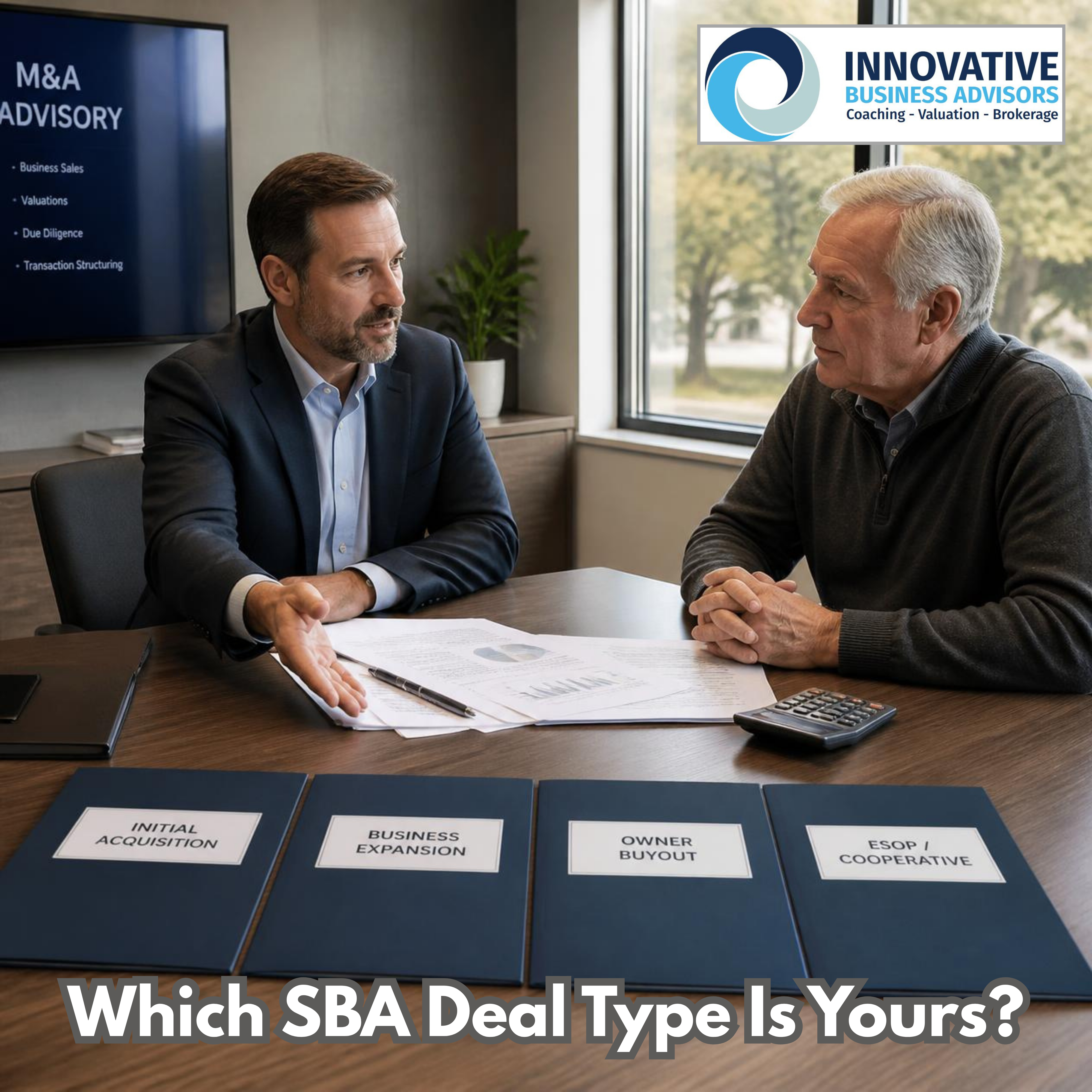
Starting October 1, 2026, the SBA requires every business sale financed with a 7(a) loan to be classified into one of four categories: Initial Acquisition, Business Expansion, Owner Buyout, or ESOP & Cooperative. The category your deal falls into determines how much cash the buyer needs up front, what financial reports the bank must order, and how strong the earnings need to be to support the loan. If you are planning to sell your business, you need to understand which category your deal will land in — because it directly affects your sale price, your timeline, and your deal structure.
Key Takeaways
 Every SBA-financed business sale must now be classified into one of four categories, and the lender must enter the category into the SBA Loan System.
Initial Acquisition is the default. The lender must document in writing why a deal qualifies for any other category.
The category determines the buyer’s minimum down payment, the required debt service coverage ratio, and the level of financial due diligence.
Business Expansion gets the most favorable terms — but only if the buyer has operated a similar business for at least two years.
Owner Buyouts have new guardrails for bringing in outside investors.
What Are the Four SBA Transaction Categories?
Starting October 1, 2026, the SBA’s updated lending rules (SOP 50 10 8.1) require every change of ownership financed with a 7(a) loan to be placed into one of four categories. Think of these categories as buckets. Each bucket has its own set of rules for how the bank handles the loan. The lender picks the bucket, documents the choice in the credit memo, and enters it into the SBA’s system.
This matters to you as a seller because the bucket your buyer’s deal lands in controls three things: how much money the buyer must bring to the table, how closely the bank will examine your books, and what earnings ratio the deal must hit. Same business, same buyer — but a different category can mean a different outcome.
Here is what each one means.
What Is an Initial Acquisition?
An Initial Acquisition is any deal where a new owner — someone who was not previously an employee or owner of the business — ends up as the majority or largest individual owner. This is the most common type of business sale, and it is the default category. If the lender cannot document that the deal fits into one of the other three buckets, it lands here.
Initial Acquisitions carry the strictest requirements. The buyer must put down at least 10% equity, and that requirement cannot be reduced or waived. The deal must show a debt service coverage ratio of 1.25:1 — meaning the business must earn $1.25 for every $1.00 of debt payments. And if the purchase price is $3 million or more, the bank must order both an independent business valuation and a Quality of Earnings report.
If you are selling your business to someone who does not already own a piece of it and is not already working there, this is almost certainly where your deal will land.
What Is a Business Expansion?
A Business Expansion is when an existing operating business purchases another business. This is not someone buying their first company — it is an owner who already runs a business adding a second one.
To qualify, three conditions must be met:
- The buyer’s existing business must have been operating for at least two full fiscal years under its current ownership.
- The business being acquired must be in the same four-digit NAICS industry group as the buyer’s existing business.
- And the deal must result in the same number (or more) of full personal guarantors as existed before the transaction.
Why does this matter? Because Business Expansion gets the most favorable treatment. The debt service coverage ratio is 1.15:1 instead of 1.25:1, and the lender has the ability to reduce or even eliminate the 10% equity requirement if the buyer has strong liquidity and working capital. The buyer’s balance sheet must not show negative net worth at the last fiscal year-end.
If you are selling to a competitor, a company in your industry, or a strategic buyer who already runs a similar operation, this is the category you want the deal to qualify for. It gives the buyer the most room.
What Is an Owner Buyout?
An Owner Buyout is a deal that changes the ownership structure of the business without acquiring a different company. At least one original owner must remain in place after the transaction and personally guarantee the loan.
There are two types.
- Existing Owner Buyout is a transaction between current owners — one partner buying out another. Both the business and the acquiring owner must be co-borrowers on the loan.
- Partial Change of Ownership is when a new person buys some or all of a departing owner’s interest while at least one original owner stays. Under the new rules, the operating company and every new owner must be co-borrowers, no matter how small their stake. Even a 1% ownership interest triggers the co-borrower requirement.
The SBA added an important guardrail here. Any individual who is not currently employed by the business may only acquire less than 50% of the total equity and may not become the largest shareholder. If they would, the deal must be processed as an Initial Acquisition instead — with the stricter requirements that come with it.
Owner Buyouts require a debt service coverage ratio of 1.25:1. The baseline equity injection is 10%, but like Business Expansion, the lender may reduce or eliminate it if the buyer’s financial position supports it.
What About ESOPs and Cooperatives?
The fourth category covers sales to Employee Stock Ownership Plans (ESOPs) and cooperatives. These transactions have their own set of rules because the ownership structure is different — the employees collectively become the owners.
For most lower middle market business owners in Missouri and Illinois, this category is less common. But if you have explored selling to your employees, be aware that the debt service coverage requirement here is 1.25:1, and there is a federal statute requiring that if a seller stays on as a partial owner in an ESOP, they must provide a full, unlimited personal guarantee. That statutory requirement cannot be waived.
How Does the Category Affect My Sale?
The category drives three numbers that shape every deal.
- Equity injection — how much cash the buyer needs. Initial Acquisitions are locked at 10% with no relief. Business Expansions and Owner Buyouts start at 10% but can go lower. This directly affects how many buyers can afford your business.
- Debt service coverage — how strong the earnings must be relative to the loan payments. At 1.25:1, the business must earn 25% more than its total debt obligations. At 1.15:1 (Business Expansion only), it must earn 15% more. A lower ratio supports a higher loan amount on the same earnings.
- Financial due diligence — what reports the bank must order before approving the loan. Every category requires an independent business valuation. Deals at $3 million and above in the Initial Acquisition and Business Expansion categories also require a Quality of Earnings report. We will cover these requirements in detail in our next post.
What Should I Do Now?
If you are thinking about selling your business in the next one to three years, start by understanding which category your most likely buyer falls into. A first-time buyer with no prior ownership experience puts you in Initial Acquisition territory. A competitor or industry buyer may qualify as a Business Expansion. A partner buyout is an Owner Buyout.
The category is not something you choose — it is determined by the facts of the transaction. But knowing where your deal will land helps you plan your asking price, your deal structure, and the kind of buyer you market to.
Talk to your M&A advisor and your lender early. The rules are clear, and planning around them is far easier than discovering them at the closing table.
Frequently Asked Questions
Can the seller choose which category applies? No. The category is determined by the facts of the transaction — who the buyer is, whether they already own a business, and how the deal is structured. The lender documents the classification in their credit memorandum.
What if my buyer could qualify for more than one category? Initial Acquisition is the default. The lender must document in writing why a deal qualifies as anything else. If the lender cannot make the case, the deal is processed as an Initial Acquisition.
Does the category affect the interest rate on the loan? No. Interest rate rules are set separately and apply across all categories. The category affects equity, debt service coverage, and financial due diligence requirements.
When do these rules take effect? These rules apply to any 7(a) loan application that receives an SBA loan number on or after October 1, 2026. Applications already submitted before that date are handled under the previous rules (as of August 2026).
This post is part of a four-part series on the SBA’s new lending rules effective October 1, 2026. Up next: what the new financial due diligence requirements mean for your business sale.
The information in this post is based on SBA SOP 50 10 8.1. It is general information, not legal, tax, or lending advice. Consult your M&A advisor, lender, and legal counsel about your specific situation.