

Charitable Giving Before a Business Sale: Why Timing Can Make a Major Difference
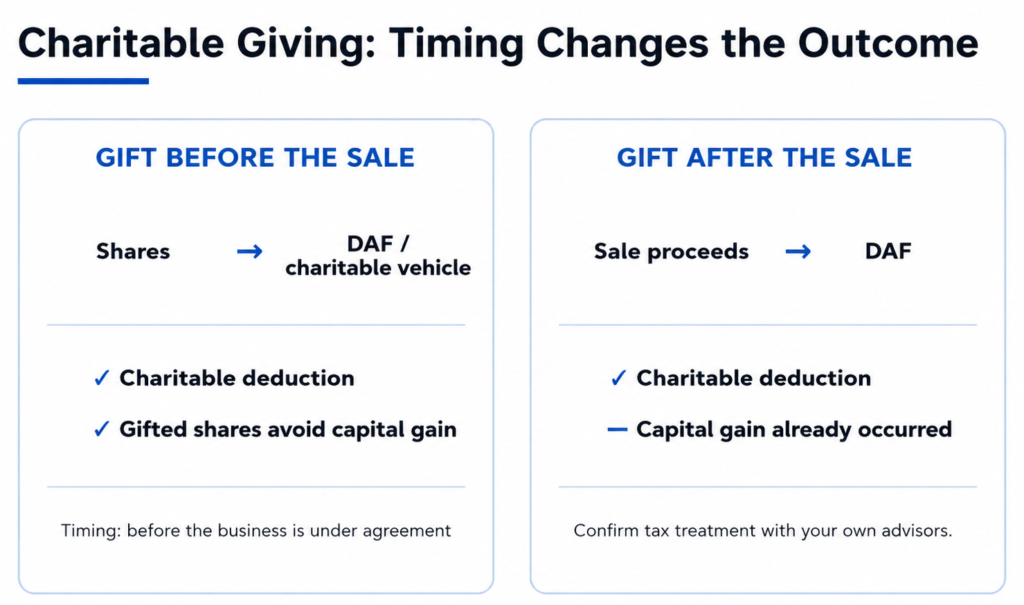
For a business owner who already intends to give to charity, the timing of that gift can be just as important as the amount. Waiting until after your business has been sold and then donating some of the proceeds may still create a charitable deduction.
But planning a gift of business ownership before the company is under agreement for sale may create additional potential tax advantages.
That’s why charitable planning should be part of the exit conversation early — not something considered after closing.
Giving Shares Instead of Sale Proceeds
Consider a simplified example.
You own 1,000 shares of your company and already know you want approximately 10% of your wealth from the business to eventually support charitable organizations.
Instead of selling all 1,000 shares and later donating some of the cash, you might work with your tax, legal and wealth advisors to determine whether gifting 100 shares before the business is under agreement is appropriate.
When properly structured, this may potentially provide two benefits:
* A charitable deduction for the value of the donated shares
* The donated shares may avoid the capital-gains tax that otherwise could have occurred had you sold the shares first
The timing is critical. Once a sale is already under agreement, some of these planning opportunities may no longer be available.
Donor-Advised Funds vs. Charitable Remainder Trusts
Two charitable-planning tools that may be considered are donor-advised funds and charitable remainder trusts.
Donor-Advised Fund
A donor-advised fund, or DAF, is a charitable giving account that can hold contributed assets. You may receive a charitable deduction when the contribution is made while recommending grants to qualified charities over time.
That means the tax deduction and the eventual charitable distributions don’t necessarily have to occur at the same time.
Charitable Remainder Trust
A charitable remainder trust, or CRT, is structured differently. It can provide income to you or other beneficiaries, with the remaining assets ultimately passing to charity.
One strategy is primarily designed around charitable giving, while the other can incorporate an income component.
Which — if either — is appropriate depends entirely upon the owner’s circumstances and objectives.
Why the Year of the Sale Matters
A business sale may create one of the largest taxable events of an owner’s life. A properly planned charitable gift may potentially generate a deduction in that same year.
The owner can then distribute money from a donor-advised fund to charities over time rather than feeling pressured to make every charitable decision during the year the business is sold.
The sale and deduction may occur today. The giving can continue for years.
The Cost of Waiting
The importance of advance planning became especially clear in the case of two brothers who had to sell their family business unexpectedly.
One brother was deeply charitable. Had there been more time before the transaction, a portion of his ownership potentially could have been gifted before the sale, creating a resource capable of supporting his charitable giving for decades.
But circumstances forced the transaction forward. There wasn’t enough time.
That’s the recurring theme of exit planning:
Some opportunities can’t be recreated after the fact.
Make Charitable Planning Part of the Exit Conversation
If charitable giving is already important to you and your family, tell your advisory team early. Don’t wait until the transaction documents are being prepared.
Your CPA, attorney, wealth advisor and M&A advisor can then work together to determine whether charitable planning belongs in your overall exit strategy.
The objective isn’t to make a charitable gift simply to reduce taxes. It’s to make the giving you already want to do as thoughtfully and efficiently as possible.
Important: Tax laws and individual circumstances change. Charitable strategies involving privately held business interests can be complex. Always work with qualified tax, legal and financial professionals before transferring business interests or implementing any charitable strategy.
Coming Next
Part 5: Life After Selling Your Business: Preparing for Closing, Day One and the Next Chapter
The final part of our series looks beyond taxes and transaction documents to something owners often underestimate: what happens after the business is no longer theirs.
This article is part of our five-part business exit planning series based on insights shared during a webinar featuring Steve Denny of Innovative Business Advisors and Jim Matush and Ryan Wagner of Trinity Wealth Advisors (Trinity Wealth Advisors Financial Advisors, St, Louis MO). To hear the complete conversation and additional insights from Steve, Jim and Ryan, watch the full webinar replay on YouTube.