

How Much Is Your Business Really Worth? Why Valuation Should Come Before the Sale
If your business represents 50%, 70% or even 90% of your net worth, there’s one number you can’t afford to guess:
What is the business actually worth?
Yet many owners have never obtained an independent business valuation.
They may have a number in mind based on what another company sold for, what they’ve invested over the years or simply what they believe the business should be worth.
But none of those substitutes for a professional valuation.
“What you value, you can impact.”
— James Matush, Trinity Wealth Advisors
Knowing your company’s value doesn’t just prepare you for a future sale.
It gives you an opportunity to change the number while you still have time.
What Determines the Value of a Business?
Three broad areas can contribute to value:
1. Business Performance
Revenue, profitability, cash flow, growth and other financial measures provide the foundation.
But the financial statements aren’t the entire story.
2. Strategic or Market Value
A company may have value to a particular buyer because of its customers, geographic presence, intellectual property, capabilities, licenses or other strategic advantages.
Even a struggling business can possess strategic value.
A competitor may see something in the company that’s valuable to them.
And that doesn’t necessarily mean you have to sell. In some situations, a licensing or affiliate arrangement could allow you to monetize strategic value without transferring the entire business.
3. Asset Value
Equipment, property and other tangible and intangible assets also contribute to the overall picture.
Owners should pay particular attention to assets that aren’t currently being used.
Equipment that’s shut down during a slow period may still have considerable value today. Leave it idle for years and it can eventually become scrap.
Monetize assets while they still have a market.
Business Owners Often Don’t Feel Wealthy
An owner may spend decades putting profits back into the company.
Their wealth doesn’t necessarily appear as cash sitting in an investment account.
It’s embedded in the business itself.
“The average business owner does not feel wealthy. Their business is worth money.”
— James Matush, Trinity Wealth Advisors
That’s why a valuation can be eye-opening.
Knowing what the business is actually worth allows you and your financial advisors to answer bigger questions:
Can I afford to retire?
How much do I need from a sale?
Do I need to increase the company’s value first?
Could I transfer it to family?
What would happen if I unexpectedly had to sell?
When Circumstances Choose the Exit Date
Sometimes owners don’t get several years to prepare.
Two brothers had owned their second-generation family business for roughly 20 years when health issues and other personal circumstances forced them to sell quickly.
They had never obtained a formal valuation.
They spoke with several valuation professionals and received dramatically different opinions.
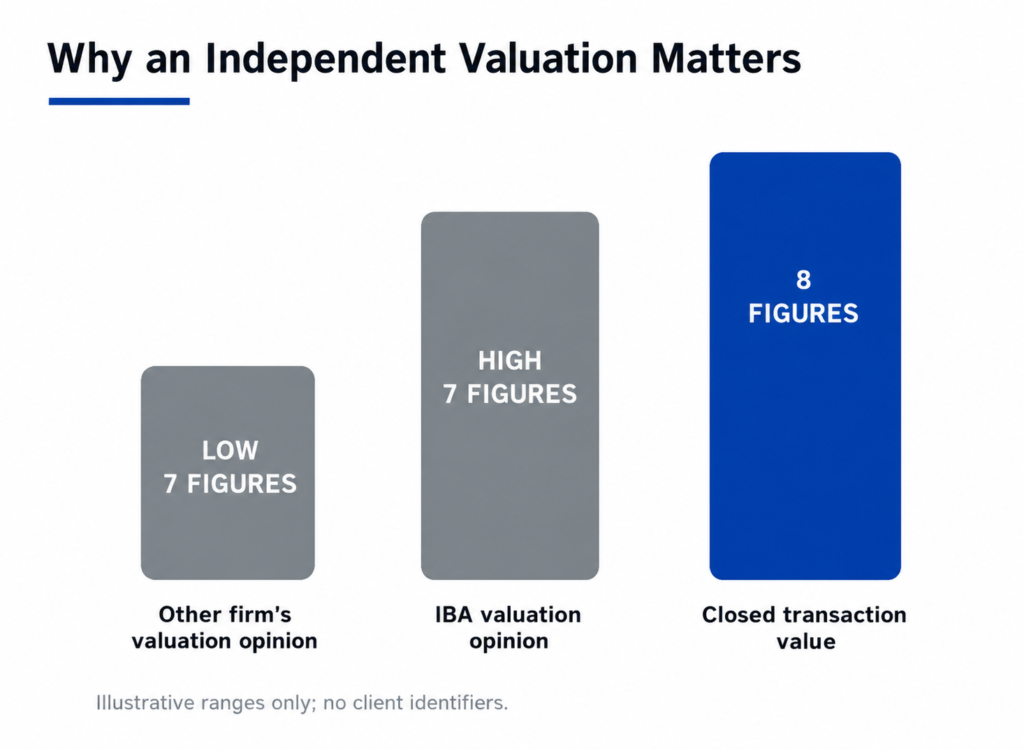
One firm valued the company in the low seven figures.
Innovative Business Advisors valued it in the high seven figures.
Ultimately, the transaction closed at an eight-figure valuation.
That difference was potentially life-changing.
The brothers were fortunate in another respect: years earlier, they had converted their family’s C corporation to an S corporation. By the time circumstances forced the sale, the entity had already seasoned.
But much of the remaining planning had to happen quickly.
Their experience illustrates an important point:
You don’t get a valuation because you’re selling. You get a valuation so you’re prepared if and when you decide — or need — to sell.
Valuation Gives You Time to Improve
Suppose you plan to exit in five years and discover today that your company is worth less than you expected.
That’s disappointing.
But it’s also useful.
You now have five years to understand why.
Perhaps the business has excessive customer concentration. Maybe profitability needs improvement. Perhaps certain assets aren’t producing value. The business could be overly dependent upon you personally.
Those are issues you may be able to change.
Discovering them during due diligence is too late.
Discovering them years beforehand gives you choices.
Stop Guessing at Your Largest Asset
For many owners, the business is the largest asset on the family’s personal balance sheet.
Yet it may also be the only major asset whose value they don’t actually know.
A professional, independent valuation replaces assumptions with information.
And information gives you the ability to plan.
If you’re considering a future business transition, Innovative Business Advisors can help you understand what your business is worth through a professional business valuation. Knowing that value early can provide an important foundation for charitable, tax and exit planning—and give you and your advisors more time to evaluate your options before a sale is underway.
For more information regarding our valuation services, please visit:
innovativeba.com/business-valuation-services/
Coming Next
Part 4: Charitable Giving Before a Business Sale: Why Timing Can Make a Major Difference
For owners who are charitably inclined, planning a gift before a transaction is under agreement may create opportunities that disappear once the deal is already underway.
This article is part of our five-part business exit planning series based on insights shared during a webinar featuring Steve Denny of Innovative Business Advisors and Jim Matush and Ryan Wagner of Trinity Wealth Advisors (Trinity Wealth Advisors Financial Advisors, St, Louis MO). To hear the complete conversation and additional insights from Steve, Jim and Ryan, watch the full webinar replay on YouTube.