

Is Your Business Ready to Sell? How to Strengthen the Company Before an Exit
A successful business exit doesn’t begin when the company is listed for sale.
It begins while you’re still running it.
Some of the biggest obstacles to a successful transaction — excessive customer concentration, an inefficient business structure and messy financial statements — can take months or even years to correct.
That’s why one of the best things an owner can do is begin looking at the company through the eyes of a future buyer long before that buyer arrives.
Reduce Customer Concentration Risk
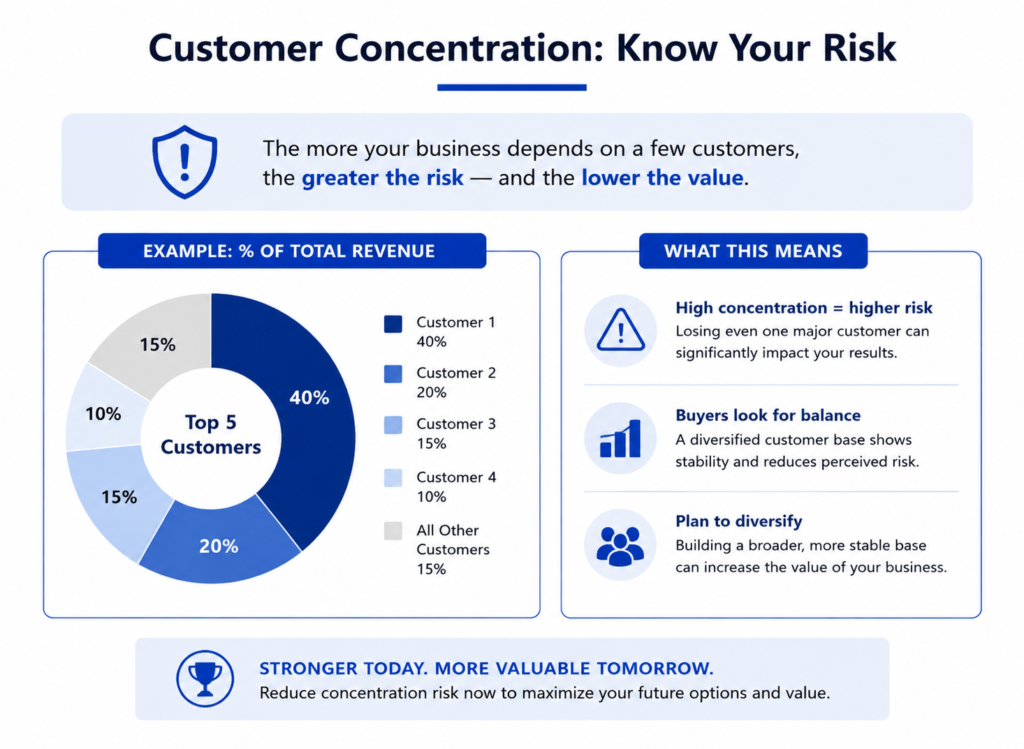
A company can be profitable and still carry significant risk if too much revenue comes from one customer.
Trinity Wealth Advisors worked with a couple whose business lost a customer representing approximately 60% to 70% of its revenue.
The impact didn’t end that year.
The company continued declining for six to eight years. Eventually, the owners exited without a sale.
Their retirement plan had been tied to the company, leaving them in their sixties rebuilding financially with their faith and equity from a home they sold.
Nobody in that story had done anything foolish.
They built a business that lost a customer.
But it demonstrates why customer diversification matters long before an exit.
Ask yourself:
* What percentage of revenue comes from our largest customer?
* What happens if that customer leaves tomorrow?
* How quickly could we replace that revenue?
* Would a buyer view this concentration as a major risk?
Reducing customer concentration can make the business both stronger today and more attractive tomorrow.
Review Your Business Structure Early
Your corporate structure can also have enormous implications when it’s time to sell.
Many companies built by baby boomer business owners remain C corporations.
Depending on the eventual transaction, converting a C corporation to an S corporation may potentially help address double taxation — but this is not necessarily something you can do shortly before closing.
Certain transactions require significant seasoning periods.
That means business structure should be reviewed years before a potential sale, not when you’re already negotiating with a buyer.
Talk with a CPA who regularly works on business transitions and ask how your current entity structure could affect different types of future transactions.
The best structure for operating the company today isn’t automatically the best structure for eventually transferring it.
Clean Up Your Financial Statements
Imagine you’re considering buying a business.
One of the first things you’re likely to examine is its financial information.
That’s why your operating statements should be current, accurate and easy to understand.
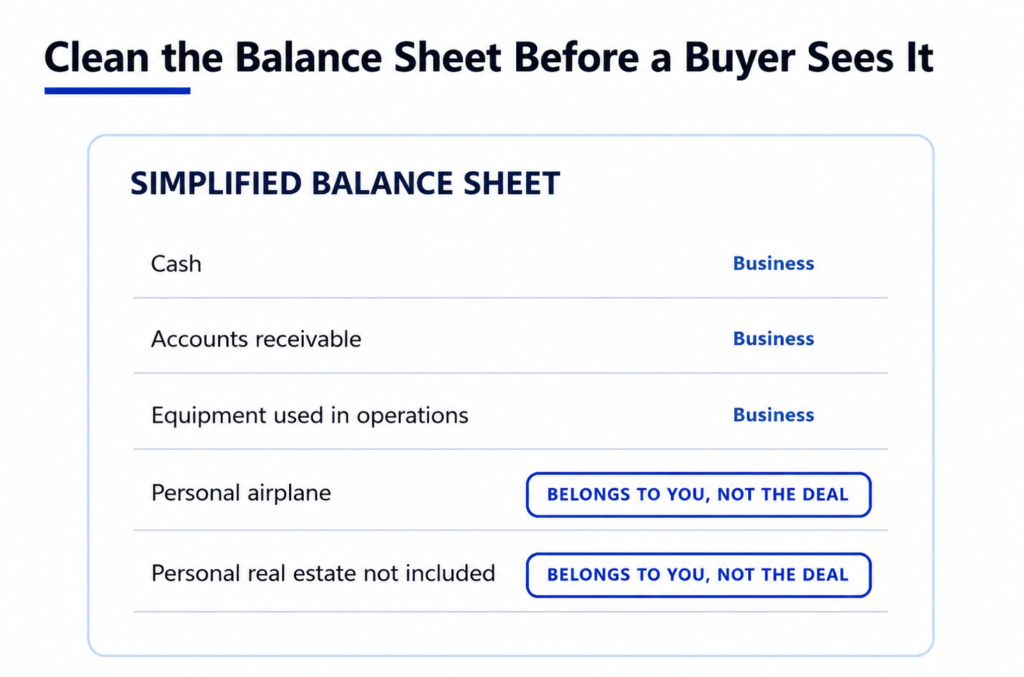
Personal assets or expenses that aren’t truly part of the business can make the company’s financial picture unnecessarily complicated.
IBA once worked with a business owner who had an airplane on the company’s balance sheet even though the owner had no intention of including the airplane in the sale.
That’s the type of issue you want to address before due diligence.
A prospective buyer should be able to clearly distinguish between:
What belongs to the business being purchased
and
What belongs to you personally.
Look at the Company Like a Buyer
Preparing a company for an eventual exit is really an exercise in reducing uncertainty.
Consider asking:
* Are our financial statements current and accurate?
* Are personal assets mixed with company assets?
* Are our tax filings correct and current?
* Are we overly dependent on one customer?
* Are key employees staying with the company?
* Does our entity structure make sense for a future transaction?
* Are there idle assets that should be sold while they still have value?
Even equipment deserves attention.
Machinery that sits unused for years can eventually go from being a valuable business asset to little more than scrap.
Monetize assets while they still have a market.
A Stronger Business Gives You More Choices
Preparing for a sale doesn’t mean you have decided to sell. In fact, many of the things that make a company more attractive to buyers also make it a better business to own.
* Diversified customers reduce risk.
* Accurate financial statements improve decision-making.
* The right entity structure can provide flexibility.
* Well-managed assets preserve value.
And a business that isn’t completely dependent upon its owner is usually more transferable. You may ultimately sell to a competitor, private equity group, employee, family member or another buyer entirely.
Or you may decide not to sell at all.
Either way, strengthening these areas gives you more options.
Coming Next
Part 3: How Much Is Your Business Really Worth? Why Valuation Should Come Before the Sale
We’ll look at why owners frequently misunderstand the value of their companies — and why knowing the number years before an exit can change what’s possible.
This article is part of our five-part business exit planning series based on insights shared during a webinar featuring Steve Denny of Innovative Business Advisors and Jim Matush and Ryan Wagner of Trinity Wealth Advisors (Trinity Wealth Advisors Financial Advisors, St, Louis MO). To hear the complete conversation and additional insights from Steve, Jim and Ryan, watch the full webinar replay on YouTube.
Read More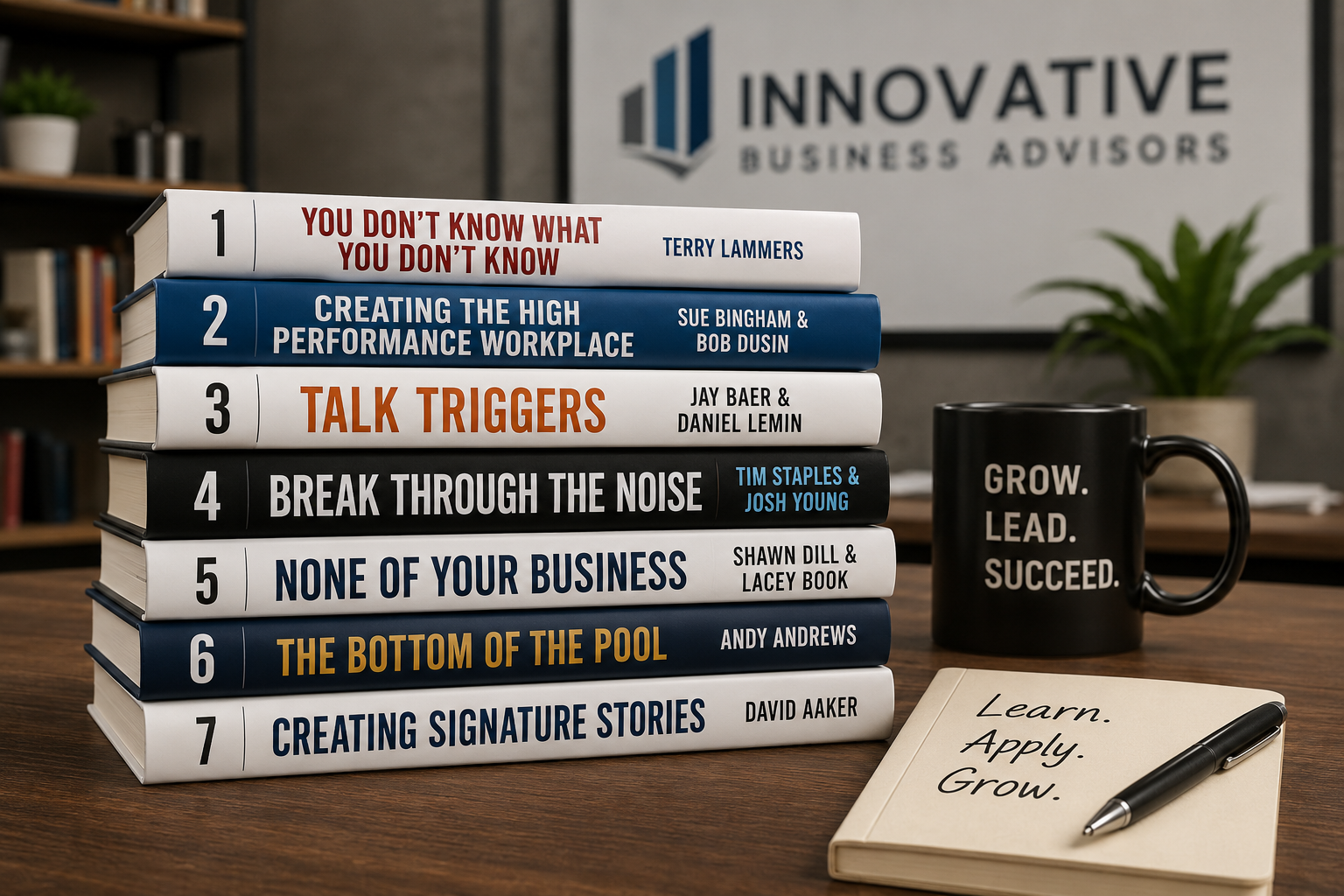
7 Must-Read Books That Will Help Entrepreneurs Grow Their Business
Every entrepreneur knows that scaling a business isn’t just about hard work — it’s about continuous learning. Successful founders absorb knowledge from every angle: leadership, marketing, strategy, and even merger-and-acquisition planning. That’s why reading the right books can be one of the smartest actions a business leader takes. In the Forbes article “The Best Books to Help Entrepreneurs Grow a Business,” top titles were curated to help business owners at every stage — from startup to expansion.
Here’s a closer look at those standout reads and why you should consider them for your next business-building bookshelf.
📖 1. You Don’t Know What You Don’t Know — Terry Lammers
Kicking off the Forbes list is You Don’t Know What You Don’t Know: Everything You Need to Know to Buy or Sell a Business by Terry Lammers—a distinction that speaks to both the relevance and impact of his work. Terry is not only the author of this highly regarded book, but is also the Managing Partner of Innovative Business Advisors.
In the book, Terry draws from decades of real-world experience helping business owners navigate growth, acquisitions, exit planning, and succession strategies. These are the same core areas where Innovative Business Advisors works closely with privately held companies—providing guidance on buying and selling businesses, business valuations, exit readiness, and strategic planning.
At Innovative, the mission is simple: help business owners maximize value and make informed decisions at every stage of ownership. You Don’t Know What You Don’t Know reflects that philosophy by shedding light on critical issues many entrepreneurs don’t realize they should be addressing until it’s too late. Whether an owner is years away from a transition or actively considering a sale, the insights in this book align directly with our advisory services.
The recognition of Terry’s book by Forbes reinforces the depth of experience and practical knowledge behind Innovative’s team—and why proactive planning can make a meaningful difference in the outcome of a business journey.
📘 2. Creating the High Performance Workplace — Sue Bingham & Bob Dusin
Growth isn’t possible without effective teams. Bingham and Dusin explore how to cultivate a workplace where employees act like owners — giving direction on fostering engagement, accountability, and a culture that fuels growth rather than resists change.
💡 3. Talk Triggers — Jay Baer & Daniel Lemin
Word-of-mouth still rules. Baer and Lemin show how to deliberately design customer experiences that people talk about, helping your business grow organically through referrals instead of expensive advertising.
📈 4. Break Through the Noise — Tim Staples & Josh Young
Standing out in today’s crowded digital landscape can feel impossible — but this book offers real strategies for boosting your brand visibility through smart online marketing, without breaking the bank.
💡 5. None of Your Business — Shawn Dill & Lacey Book
For many visionaries, the leap from dreamer to business builder is the hardest. Dill and Book bridge that gap by helping readers think like entrepreneurs, turning passion into profit with practical, actionable steps.
🎯 6. The Bottom of the Pool — Andy Andrews
Andrews challenges entrepreneurs to question long-held assumptions and comfort-zone thinking. This mindset shift can be a game-changer — innovation often begins where certainty ends.
📖 7. Creating Signature Stories — David Aaker
Strong brands are built on memorable narratives. Aaker’s guide teaches entrepreneurs why storytelling matters and how to craft stories that bring your business, mission, and values to life.
🚀 Why These Books Matter
Reading about business strategy is a great first step — but the real growth comes from applying what you learn with the right guidance and timing. The books highlighted in Forbes blend mindset, practical action, and real-world experience to help entrepreneurs:
 Strengthen leadership and company culture,
Build brands that stand out,
Make smarter growth decisions, and
Prepare for major milestones such as acquisitions, succession planning, or an eventual sale.
At Innovative Business Advisors, these same principles are put into practice every day. We work alongside business owners to help them understand their company’s value, plan proactively for the future, and navigate complex transitions with clarity and confidence. Whether an owner is years away from an exit or simply wants to be better prepared for opportunities ahead, education paired with experienced advisory support can make all the difference.
For entrepreneurs inspired by the insights in these books, learning more about valuation, exit readiness, and strategic planning can be a natural next step. Contact us at info@innovativeba.com to learn more.
📌 Final Thought
Every entrepreneur’s journey is unique, but great books give you the advantage of learning from others who’ve walked the path before. Whether you’re just starting or aiming to grow your company to the next level, make these reads part of your strategy for success.
Read More