
Is Your Business Ready to Sell? How to Strengthen the Company Before an Exit
A successful business exit doesn’t begin when the company is listed for sale.
It begins while you’re still running it.
Some of the biggest obstacles to a successful transaction — excessive customer concentration, an inefficient business structure and messy financial statements — can take months or even years to correct.
That’s why one of the best things an owner can do is begin looking at the company through the eyes of a future buyer long before that buyer arrives.
Reduce Customer Concentration Risk
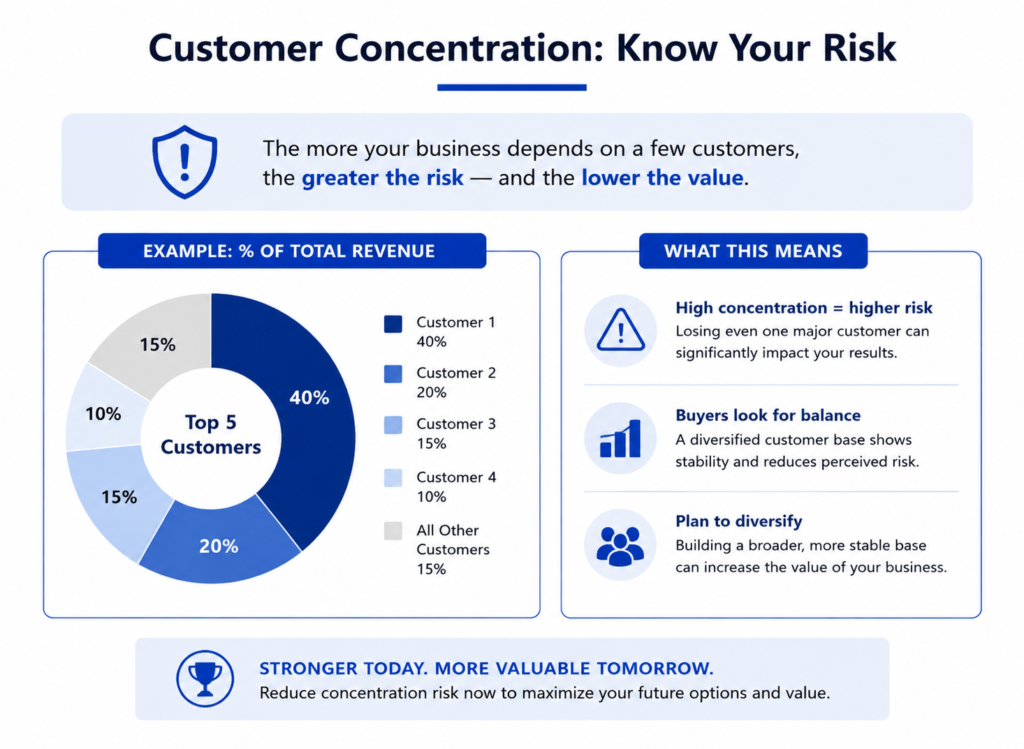
A company can be profitable and still carry significant risk if too much revenue comes from one customer.
Trinity Wealth Advisors worked with a couple whose business lost a customer representing approximately 60% to 70% of its revenue.
The impact didn’t end that year.
The company continued declining for six to eight years. Eventually, the owners exited without a sale.
Their retirement plan had been tied to the company, leaving them in their sixties rebuilding financially with their faith and equity from a home they sold.
Nobody in that story had done anything foolish.
They built a business that lost a customer.
But it demonstrates why customer diversification matters long before an exit.
Ask yourself:
* What percentage of revenue comes from our largest customer?
* What happens if that customer leaves tomorrow?
* How quickly could we replace that revenue?
* Would a buyer view this concentration as a major risk?
Reducing customer concentration can make the business both stronger today and more attractive tomorrow.
Review Your Business Structure Early
Your corporate structure can also have enormous implications when it’s time to sell.
Many companies built by baby boomer business owners remain C corporations.
Depending on the eventual transaction, converting a C corporation to an S corporation may potentially help address double taxation — but this is not necessarily something you can do shortly before closing.
Certain transactions require significant seasoning periods.
That means business structure should be reviewed years before a potential sale, not when you’re already negotiating with a buyer.
Talk with a CPA who regularly works on business transitions and ask how your current entity structure could affect different types of future transactions.
The best structure for operating the company today isn’t automatically the best structure for eventually transferring it.
Clean Up Your Financial Statements
Imagine you’re considering buying a business.
One of the first things you’re likely to examine is its financial information.
That’s why your operating statements should be current, accurate and easy to understand.
Personal assets or expenses that aren’t truly part of the business can make the company’s financial picture unnecessarily complicated.
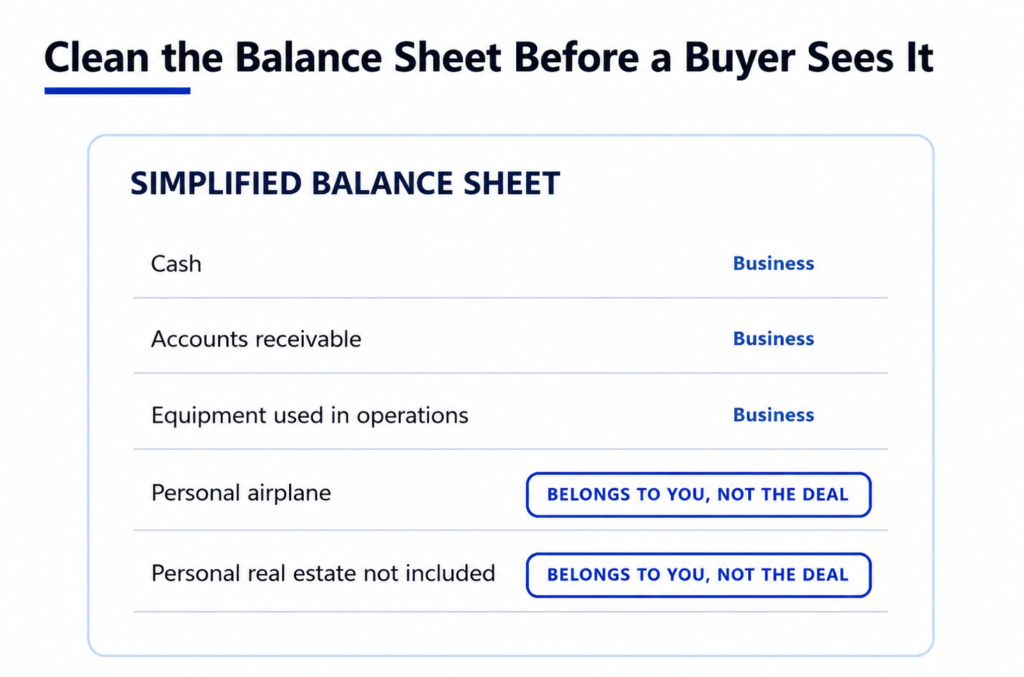
IBA once worked with a business owner who had an airplane on the company’s balance sheet even though the owner had no intention of including the airplane in the sale.
That’s the type of issue you want to address before due diligence.
A prospective buyer should be able to clearly distinguish between:
What belongs to the business being purchased
and
What belongs to you personally.
Look at the Company Like a Buyer
Preparing a company for an eventual exit is really an exercise in reducing uncertainty.
Consider asking:
* Are our financial statements current and accurate?
* Are personal assets mixed with company assets?
* Are our tax filings correct and current?
* Are we overly dependent on one customer?
* Are key employees staying with the company?
* Does our entity structure make sense for a future transaction?
* Are there idle assets that should be sold while they still have value?
Even equipment deserves attention.
Machinery that sits unused for years can eventually go from being a valuable business asset to little more than scrap.
Monetize assets while they still have a market.
A Stronger Business Gives You More Choices
Preparing for a sale doesn’t mean you have decided to sell. In fact, many of the things that make a company more attractive to buyers also make it a better business to own.
* Diversified customers reduce risk.
* Accurate financial statements improve decision-making.
* The right entity structure can provide flexibility.
* Well-managed assets preserve value.
And a business that isn’t completely dependent upon its owner is usually more transferable. You may ultimately sell to a competitor, private equity group, employee, family member or another buyer entirely.
Or you may decide not to sell at all.
Either way, strengthening these areas gives you more options.
Coming Next
Part 3: How Much Is Your Business Really Worth? Why Valuation Should Come Before the Sale
We’ll look at why owners frequently misunderstand the value of their companies — and why knowing the number years before an exit can change what’s possible.
This article is part of our five-part business exit planning series based on insights shared during a webinar featuring Steve Denny of Innovative Business Advisors and Jim Matush and Ryan Wagner of Trinity Wealth Advisors. To hear the complete conversation and additional insights from Steve, Jim and Ryan, watch the full webinar replay on YouTube.